I finished off my time in Utah with a visit to Great Basin National Park (actually in Nevada) and another short visit to Zion National Park.

Great Basin National Park is in Baker, Nevada, almost right on top of the state line with Utah. Figuring out when and how to visit it was a bit of a challenge. It was a little over 3 hours’ drive from my Utah base camp, which is a bit long for a day visit (6 hours round trip). Besides, one of the park’s main claims to fame is that it has “The Darkest Skies in North America” and a robust ranger astronomy program, which would of course mean a VERY late drive home if I stayed for that. But I wasn’t keen on pulling up stakes on my RV and taking it up there for a one-night stay, because my next stop was going to be in the opposite direction (southeast vs. northwest). It worked out to be more economical (i.e. less gas money), easier, faster, and less stressful to drive up in my truck and stay one night in a local motel.
But then I hit another snag, because I also wanted to tour Lehman Cave (the park’s main reason for existence), and I couldn’t get Saturday tickets because, once again, I didn’t jump on it quick enough when they went on sale. I got the last available Friday (August 30) ticket, and then had to choose between going to the Thursday night astronomy ranger program or waiting around until Saturday (since they don’t do it on Friday night). I initially chose Saturday, which would have still meant a late-night drive back to my RV. But I had misgivings about that, and sometime on Thursday afternoon I changed my mind, called the motel to change my reservation, tossed some clothes in a bag, jumped in my truck, and started driving.
One of the reasons I initially avoided Thursday night was because I had a church committee meeting (via Zoom) that evening… and they were counting on using my Zoom account for it, which meant I needed to be there. I wasn’t going to reach my motel quite in time for the meeting, but I thought, no worries, I will just pull off when the meeting is supposed to start and get it going for them. I should have known that was going to be an issue when I saw the warning sign about “next services.”

That last hour of my drive in western Utah was some of the most remote wilderness I have ever experienced. There was the road, and an occasional sign or fence next to it. Otherwise, there was nothing man-made in sight. Not a house, not a business, not even a barn or shed. I saw some roadrunners and a coyote (not near each other), but no Acme dynamite, thankfully. The road seemed to stretch on forever to the horizon.

Also, I had zero cell signal out there. Needless to say, my committee meeting didn’t happen. (The other committee members just chatted with each other over text to take care of business, and I apologized and added my information later.) As it turns out, I didn’t have cell signal on the Verizon network even when I reached my motel in Baker. Thankfully the motel had WiFi. I am VERY glad I didn’t try to make that drive late at night after the Saturday astronomy program. Y’all know I am not shy about traveling alone in general or late-night driving, but even I have my limits on what I consider safe. I’d have been paying for another night at the motel for sure rather than crossing that remote desert in the dark.

I arrived in Baker just before sunset and got checked in to my motel. It’s called the “Border Inn and Casino” and it does sit literally right on the state line. (In my photo, that’s the backside of the “Welcome to Utah” sign. “Welcome to Nevada” is right across the road facing the other way.) The motel office, restaurant, and casino are on the Nevada side; most of the rooms (including the one where I stayed) are on the Utah side. To make things even more fun, the state line is also the dividing line between Mountain and Pacific time zones, so technically it’s an hour earlier in the office than it is in the rooms. Fortunately, check-out time went according to Pacific Time so I had more time to get my stuff together in the morning! I don’t believe I’ve ever stayed in any hotel where the office was literally in a different state. The state line actually ran through the middle of some of the rooms, which led me to speculate about who would have jurisdiction if a crime were committed there.

After checking in, I drove on into Nevada and found my way to the Great Basin National Park amphitheater, where the ranger astronomy program was kicking off with a couple of lectures (as they waited for the sky to get dark enough for stargazing). First we heard from someone from the US Geological Survey about how early surveyors in the 1800s marked the entire country in one-mile grids (with the help of some astronomy instruments). Then we heard from a NASA Jet Propulsion Laboratory scientist who is “on loan” to the park for 12 weeks. She told us a lot about Saturn’s moon Titan and an upcoming NASA mission (scheduled for 2035) to land a quad-copter probe on it. When it was fully dark, we got to take turns looking through a couple of telescopes they had set up for us. We saw open star clusters, Saturn with its rings and its moon Titan, the Andromeda Galaxy, and the Swan Nebula (which does in fact look kind of like a swan, through a telescope!). The rangers had these amazing green laser pointers where they could point out specific stars, and you could actually tell what they were pointing at.
I don’t have any pictures from it because cell phones aren’t allowed to be taken out during the program (the light from the screen ruins everyone’s night vision), and my phone wouldn’t have taken a decent picture anyway. But the night sky view was amazing. It was a perfectly clear moonless night, and you could see the hazy cloud of the core of our own galaxy, the Milky Way, and the broad scatter of its peripheral stars across the whole sky. Here’s an approximation of what we could see:

The program wrapped up around 10:30 I think (honestly not sure which time zone…) and I made may way back to the motel for the night. In the morning, I came back to the park for the Lehman Cave Tour. Lehman Cave is about two miles of underground passages, keeping a cool 50F (10C) year-round no matter how hot the desert above it gets. It is a “wet cave,” meaning that water is constantly shaping it with stalactites and stalagmites.
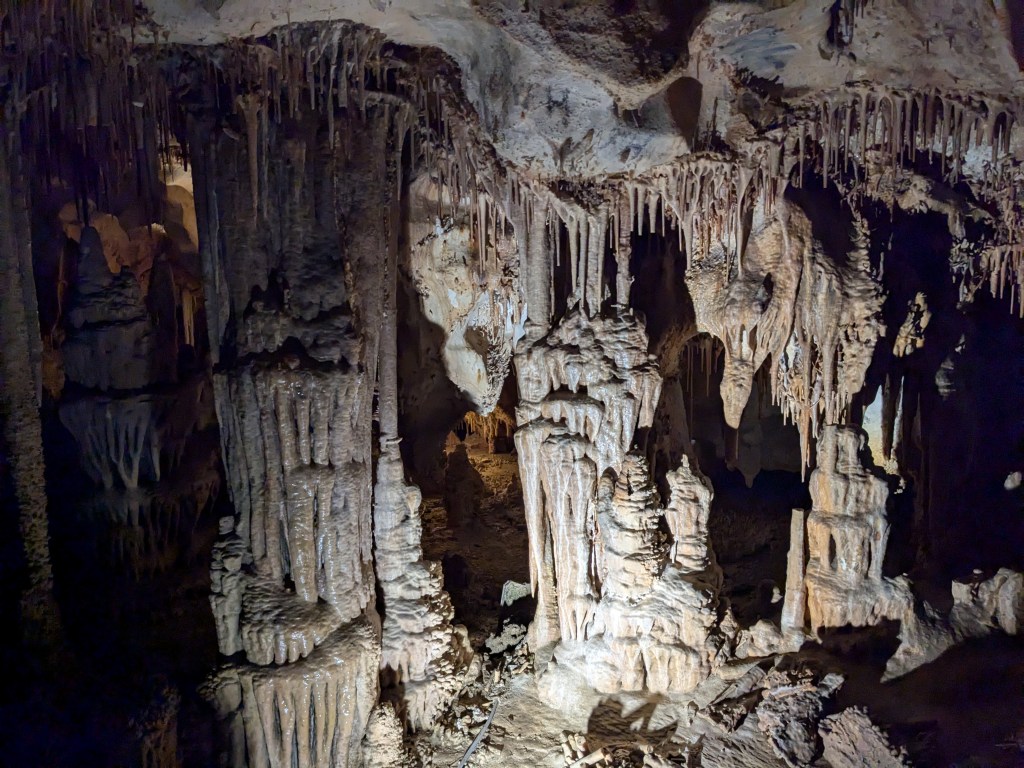
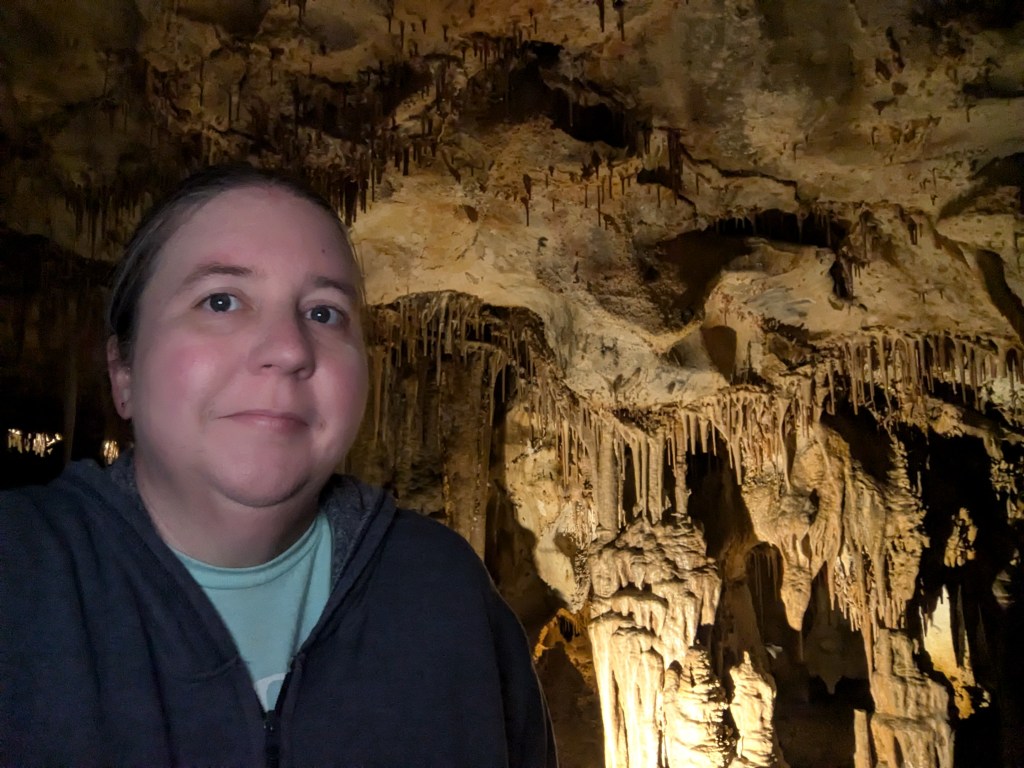
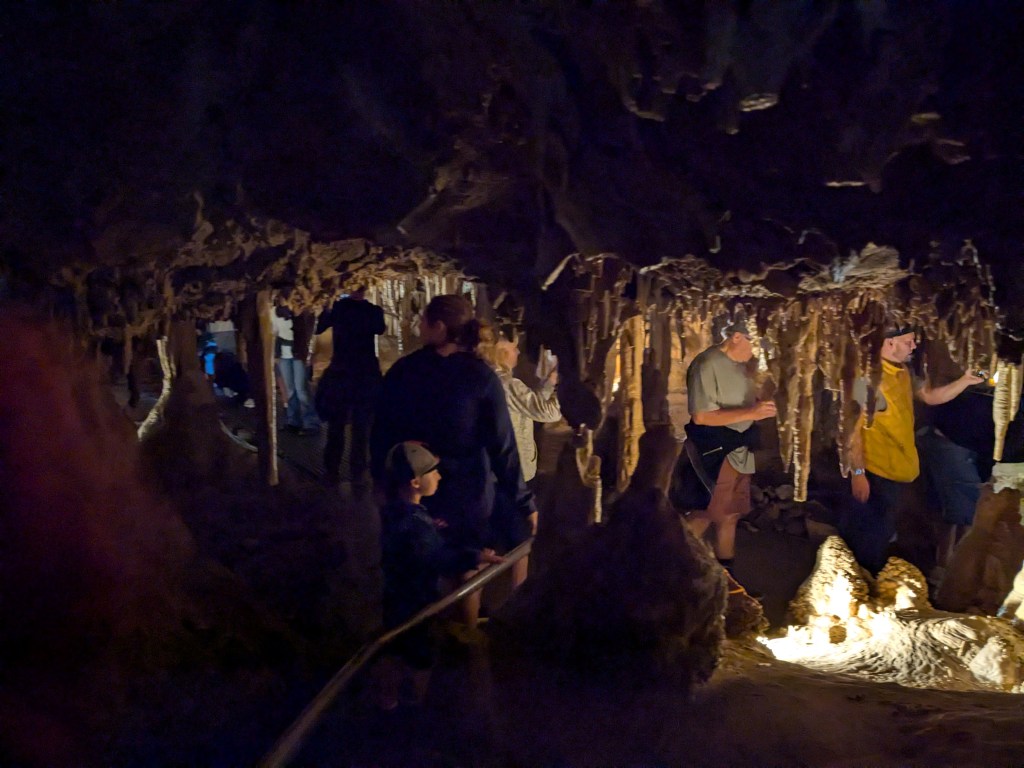
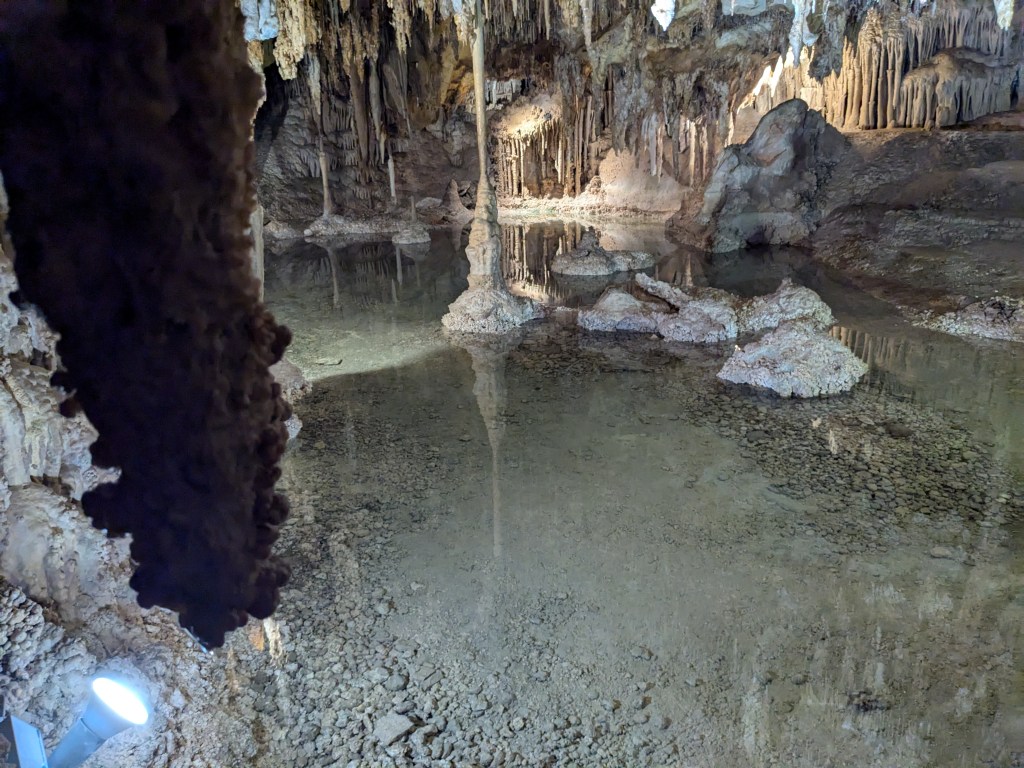
I took a lot more pictures of fantastic and intricate formations. Most of them are probably pretty similar to what you can see in other wet caves like Carlsbad Caverns, but Lehman does have one particular formation that is more exclusive to it. They call them “radishes” — basically round balls that form on the “soda straws” that eventually turn into stalactites. Scientists still have not quite figured out how or why the radishes form, but there’s a theory it’s something to do with air bubbles.

Our guide talked about how long it takes for stalactites and stalagmites to form, and to grow together into columns. I can’t quote the exact numbers, but it’s on the order of fractions of an inch per decade.
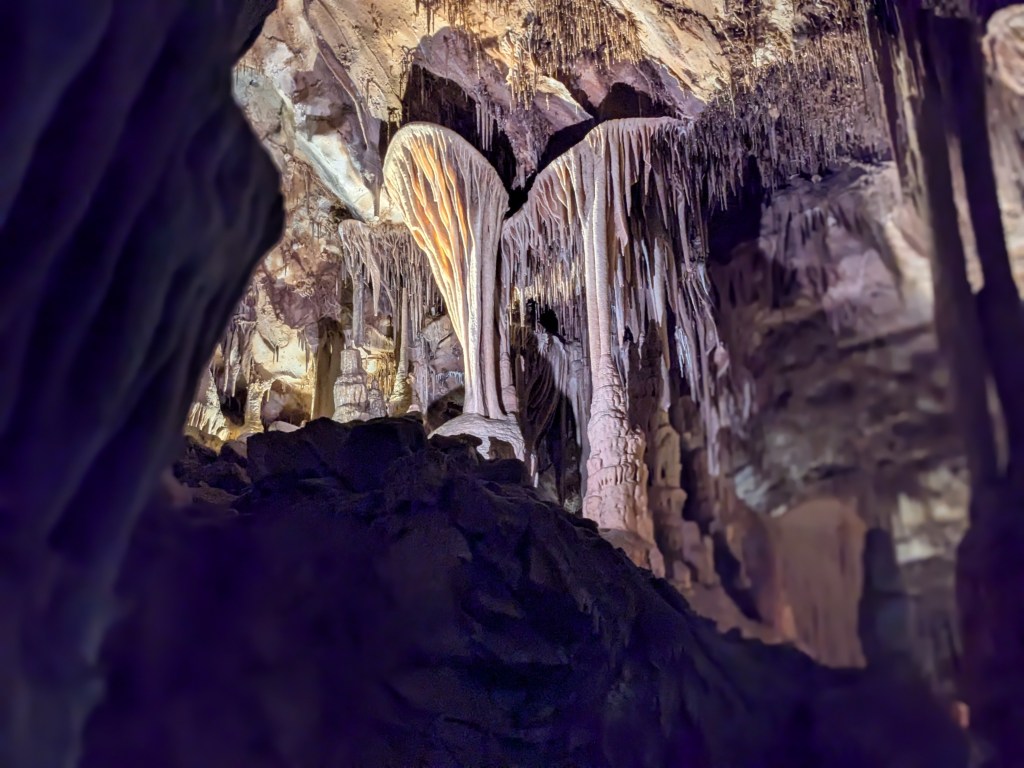
They have very serious rules about not touching anything (except the path and handrails) inside the cave, because oils from human skin stop the development of the formations.
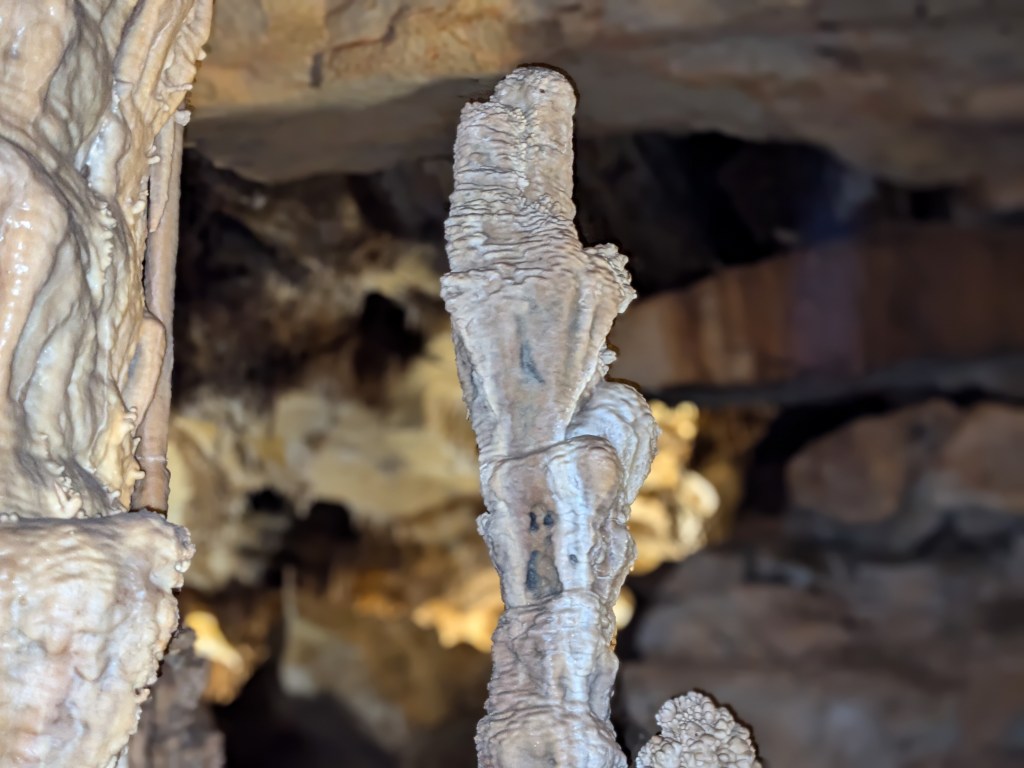
The natural entrance to the cave was pretty challenging until our old friends at the Civilian Conservation Corps made a nice entrance tunnel.
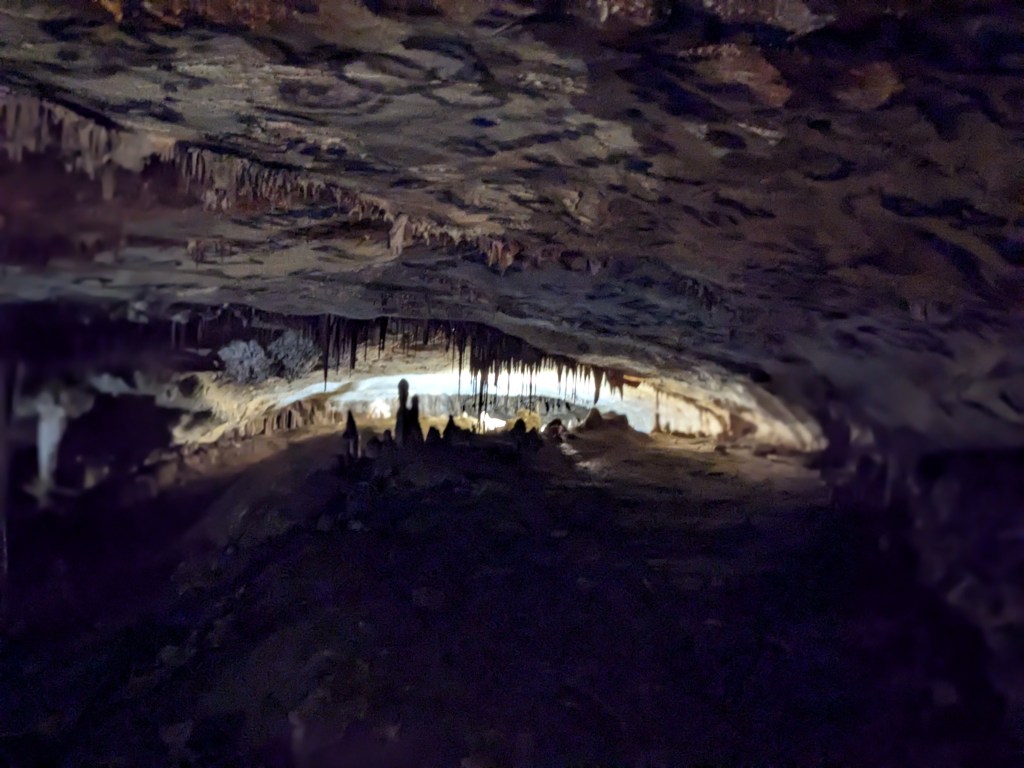
The cave has several TINY insect inhabitants (pinhead size to maybe half an inch), including these cave crickets that hang out near the entrance. The ranger gave a talk about them while we were still in the cave, complete with illustrative photos. One poor little girl COMPLETELY freaked out. I’m not sure she realized how tiny they were!

After the cave tour, I went down to the Great Basin Visitor Center to learn more about the basin itself. I had a vague general idea that the “great basin” referred to an area of land where the Continental Divide split, with rainfall to the west going into the Pacific, rainfall to the east flowing to the Gulf, and rainfall over the Basin itself remaining trapped in place until it evaporated. What I didn’t realize was how LARGE the Basin is.
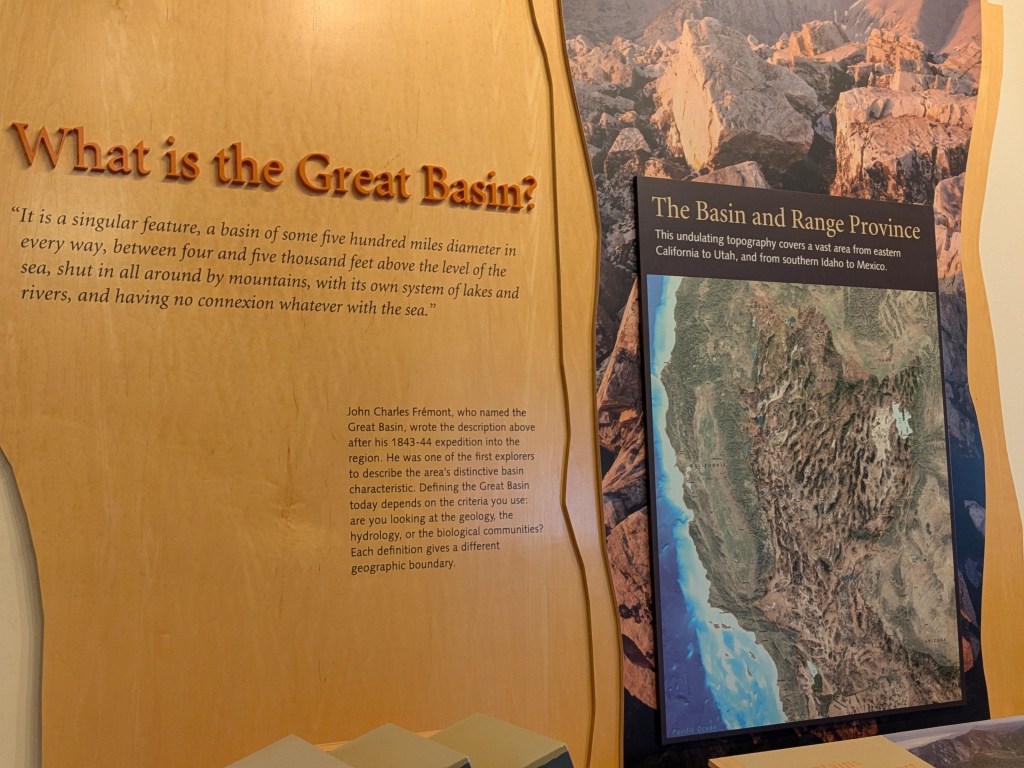
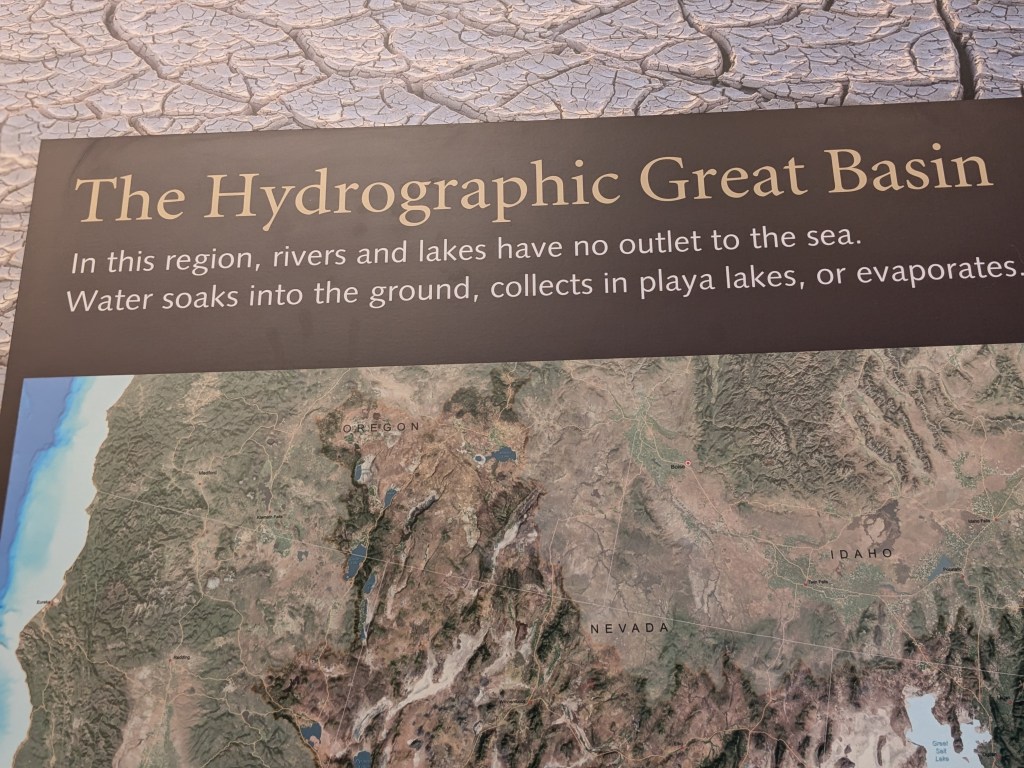

I had thought of the Great Basin as a feature of Nevada, but actually it encompasses much of Nevada and Utah, including the Great Salt Lake as well as the part of Utah where I was camped (Alton). When I thought about it, I realized it made sense that the Great Salt Lake has no outlet to the ocean… that’s why it stays so salty.
Exploring the park, I was able to see the huge variety of countryside that exists in the Great Basin based upon elevation.
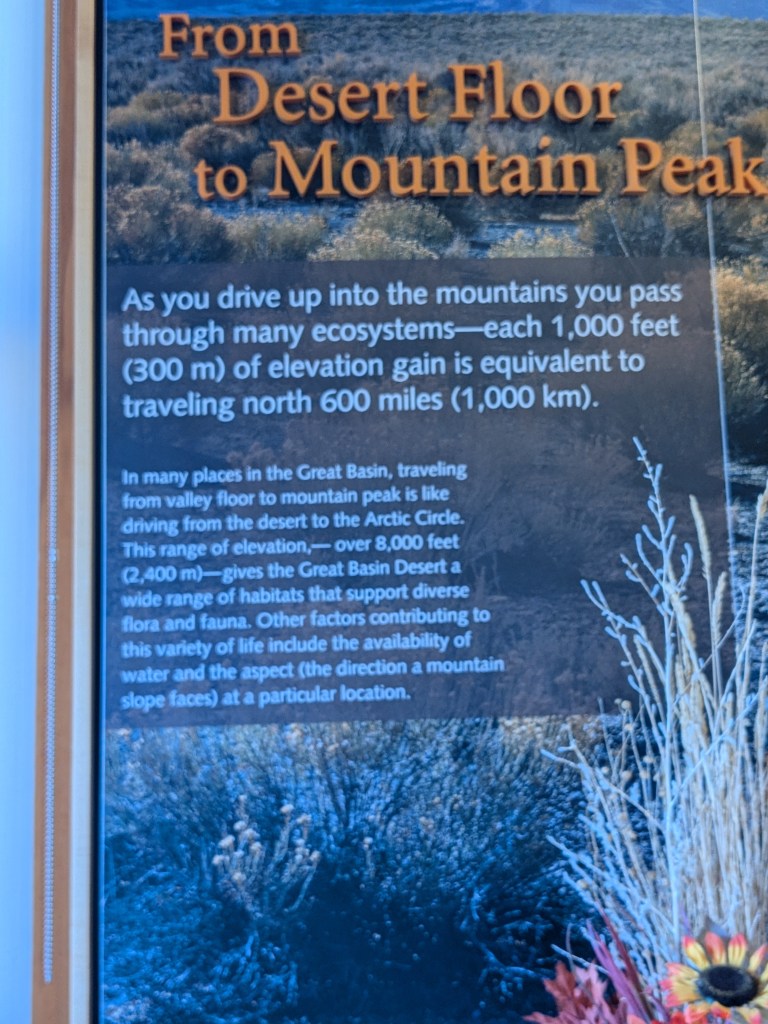
The lowest elevations are hot and dry sagebrush desert, too hot for trees. Then, as you climb, you suddenly find yourself in forests of aspen and ponderosa pine. If you keep going up from there, you pass the tree line into bare upland slopes where the air is too thin and cold for trees. I got to see this by going up the Wheeler Drive inside the park, which starts out in desert below 7,000 feet and climbs into forest over 10,000 feet. From there, you can see higher adjacent slopes that are bare above the tree line, with the remnants of a glacial moraine.

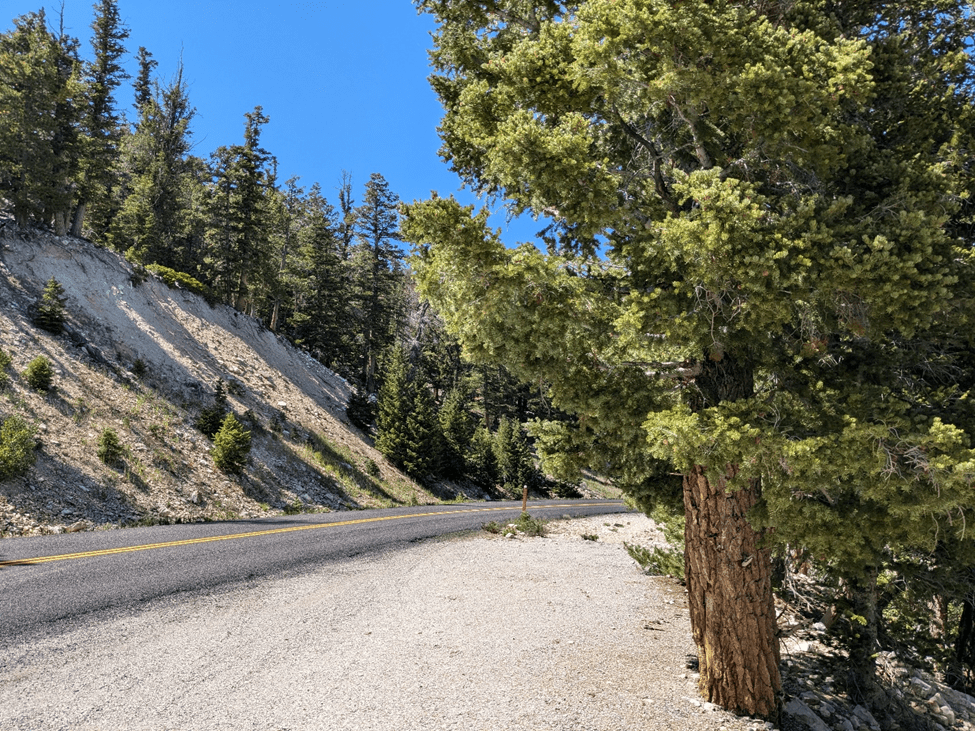
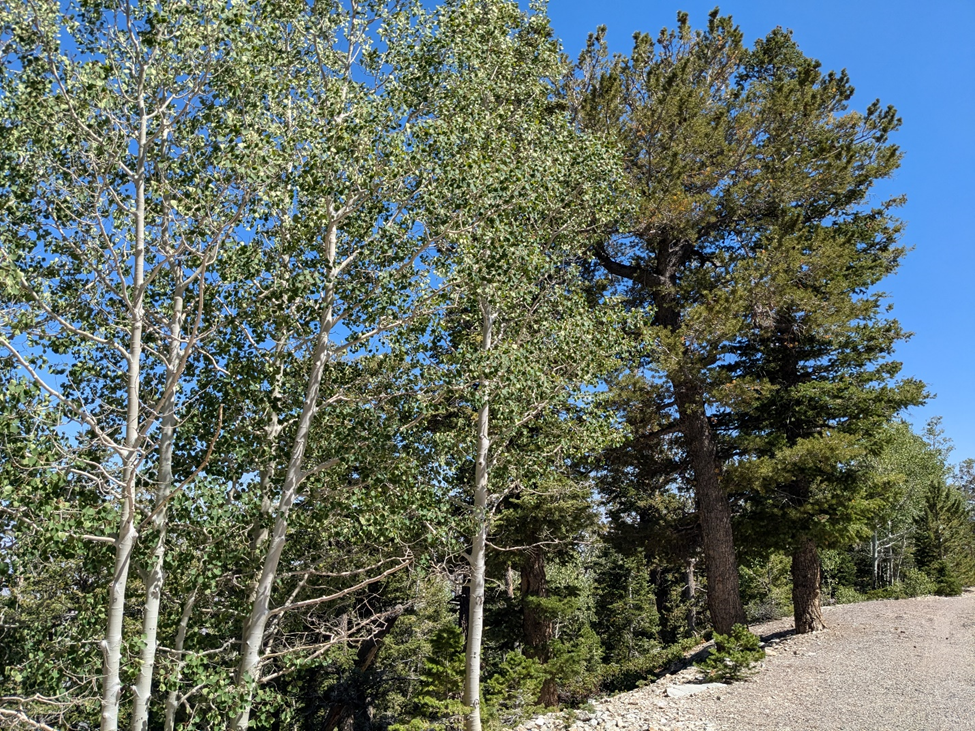
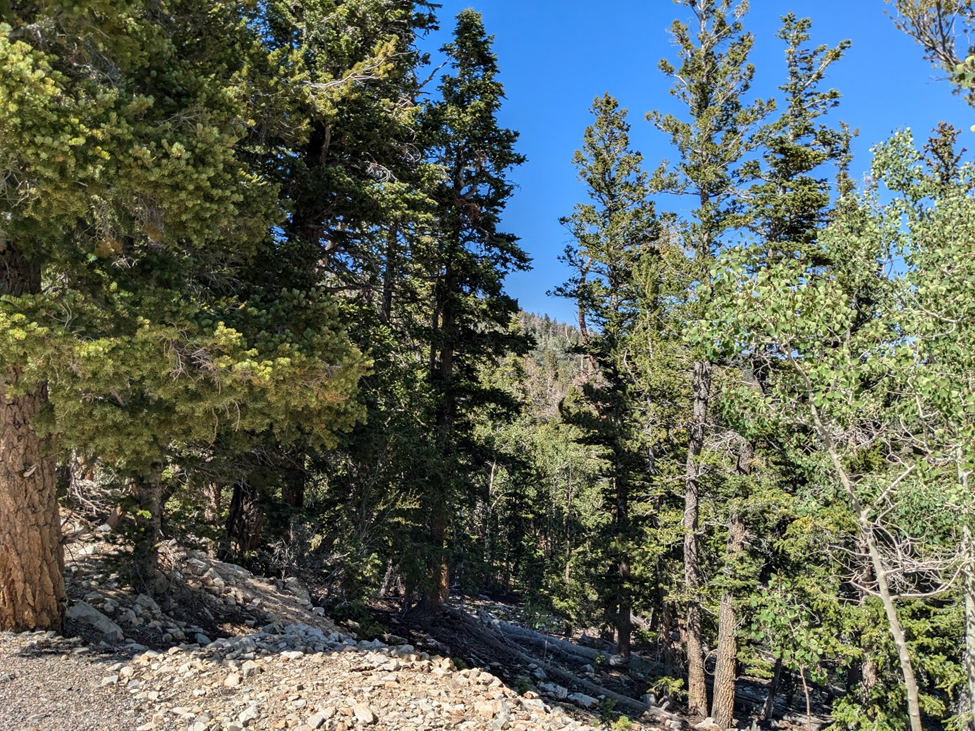

The contrasts are really stark when you pass through such different zones in such a short amount of time and space.
By the time I came back down from my mountain drive, I thought I still had a couple of hours to spend until the last item on my agenda, the ranger-led solar telescope viewing. I went back over to my motel to use the WiFi to check my email and decide whether it was worth waiting around or not. But in crossing back into Utah, I discovered that somewhere along the way my phone must have pinged a Nevada tower and updated itself to Pacific time; all of a sudden, it was an hour later than I had thought! So I did go back into the park and look through their solar telescope (properly filtered for safe viewing). The sun just looked like a small red spot through it, but if you looked closely, you could see tiny black specks that were sunspots across its face. The ranger said that each of those “specks” was the size of the Earth. Hard to get your head around that.
And with that, I’d done what I wanted at Great Basin National Park. I turned back across the wilderness for my Utah campsite again… but I had one more visit to make before pulling up stakes and heading south.
 Vivian's RV Vignettes
Leave a comment