
Tonight’s blog entry is going to be a little bit different. I will tell you about my visit yesterday to White Sands National Park, the last national park on my schedule for this year, in just a little bit. But first I feel the need to write about what else is going on in my life and travels.
“Water in the Wilderness” is the title of this post, and was also the title of the sermon preached at my home church, Access Church, last Sunday. Because of the time difference and the need to be out before the day got too hot, I was actually hiking in Saguaro National Park at the time the sermon was preached, but I watched it later online. Turns out, hiking in the desert was very appropriate preparation for watching a sermon that used an extended metaphor of water in the desert to talk about God’s care of us in the dry and dusty places of life.
The subject was not chosen at random. Our church is walking through the wilderness right now as our much-beloved lead pastor, Ted, is passing with shocking unexpectedness through the valley of the shadow. God has used Ted to bless my life through his public preaching ministry and through individual pastoral care. He has never been afraid of big emotions (including displays of his own emotion even when he’s on stage preaching) or big, hard questions. I’m still trying to get my head around the knowledge that he will soon be “absent from the body, present with the Lord.” The grief is heavy, and all the heavier for not being with my church family during this time. This is one of the costs of an itinerate lifestyle, missing out on tender moments with loved ones. But I’ve made arrangements to speed up my homeward travels a little bit — I was supposed to get home by Tuesday the 17th, but now if all goes well I should arrive late on Saturday the 14th, in time to attend church on Sunday.
With that in view, I made my visit to White Sands National Park on Wednesday morning just after dawn. I drove the Dune View loop road, hiked the Nature Trail, and finished up with a stop in the Visitor’s Center.
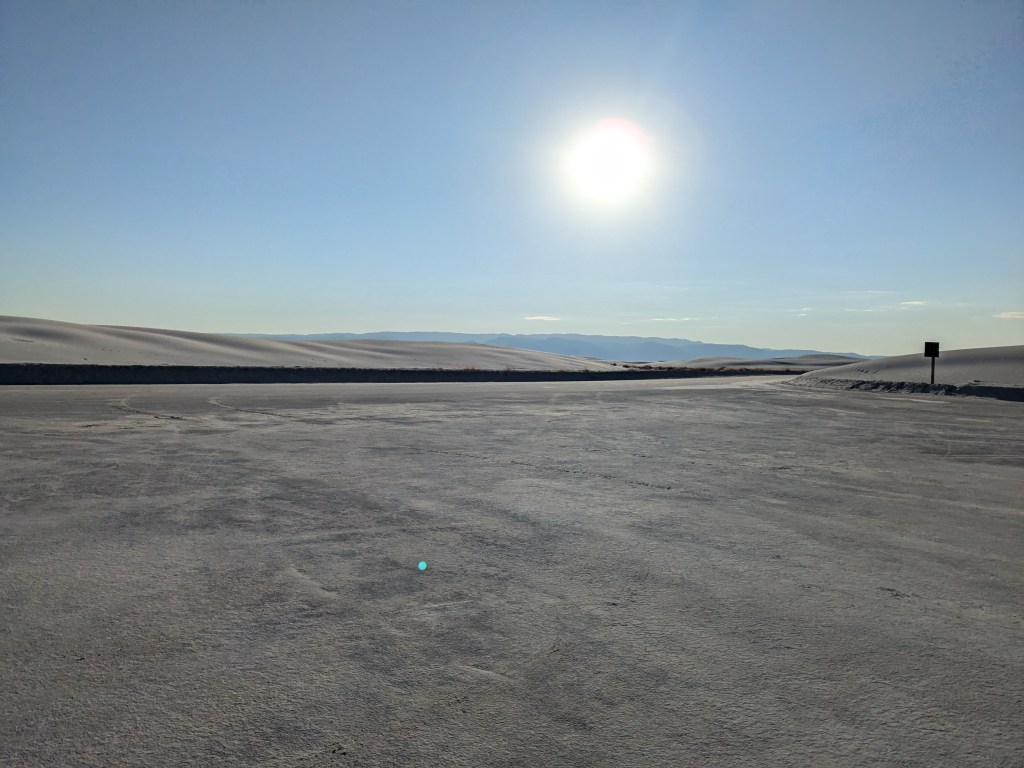
White Sands is the second-newest national park in the system (surpassed only by New River Gorge in West Virginia); it became a national monument in 1933, but only became a national park in 2019. Given the glacial pace at which the federal government moves, they still haven’t replaced the highway signs or a lot of the interpretive signage in the park, although the ranger at the Visitor’s Center said that everything has been approved now and they’re just about to start putting things up.
The dunes at White Sands are tiny compared to those at Great Dunes National park. I don’t think there’s anything there that you can’t climb in 5-10 minutes, while the biggest dunes at Great Dunes were the size of mountains and took an hour or two to climb. But these dunes are unique for their composition. They are “white” because the sand is made from gypsum, like the material in sheetrock, rather than the quartz you find in “yellow” dunes. Driving among them felt weirdly like driving through snowbanks, especially in places where the sand had been plowed up into ridges along the sides of the road.

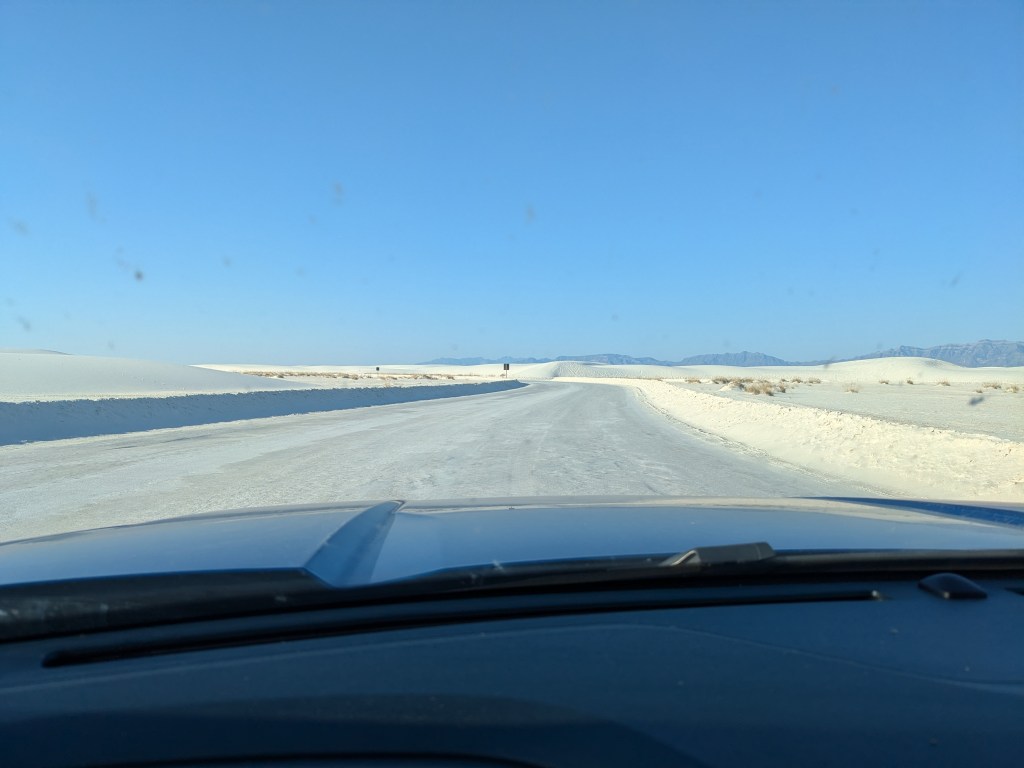
Part of the road is conventionally paved, and part of it is just hard-packed sand. But the packed sand is amazingly firm, almost like concrete. It wasn’t at all difficult to drive on, apart from being slightly bumpy in places.
The dunes near the front of the park are surrounded by grass and covered with vegetation, but they become more and more pure white sand the further back you drive. These dunes are like enormous slow-moving waves, with some migrating faster than others. The ones in the heart of the dune field can move as much as 38 feet per year, while at the edges they are more anchored in place by the vegetation; and the fast rate of movement in the center makes it hard for any vegetation to get established there without being buried in sand.
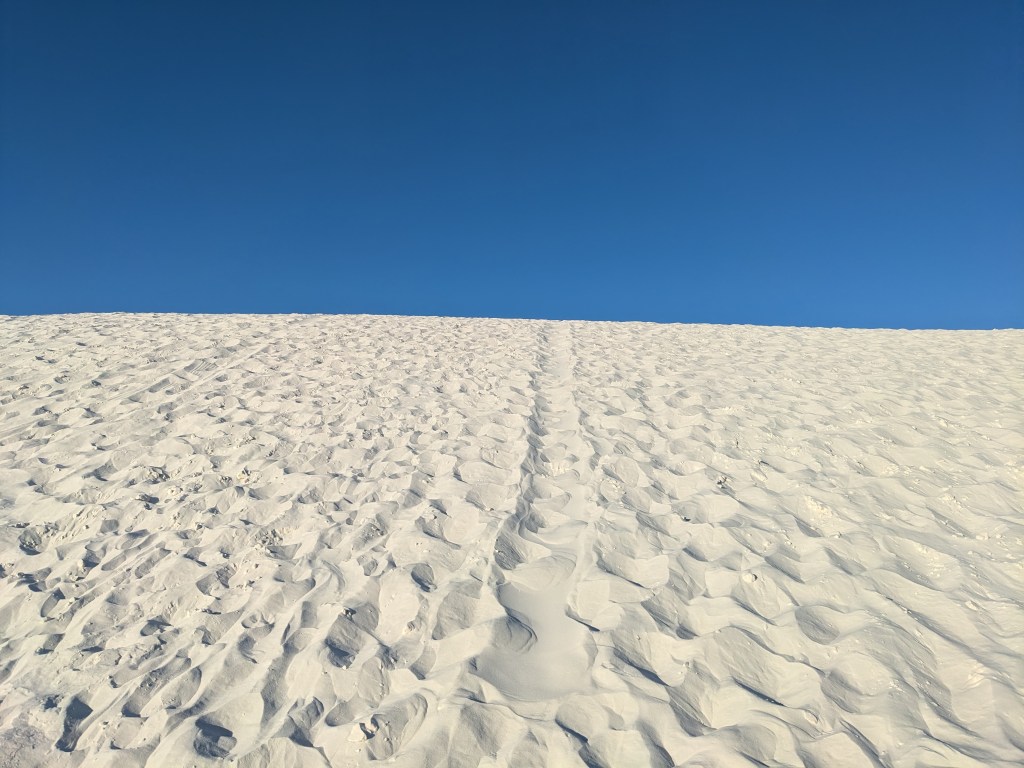
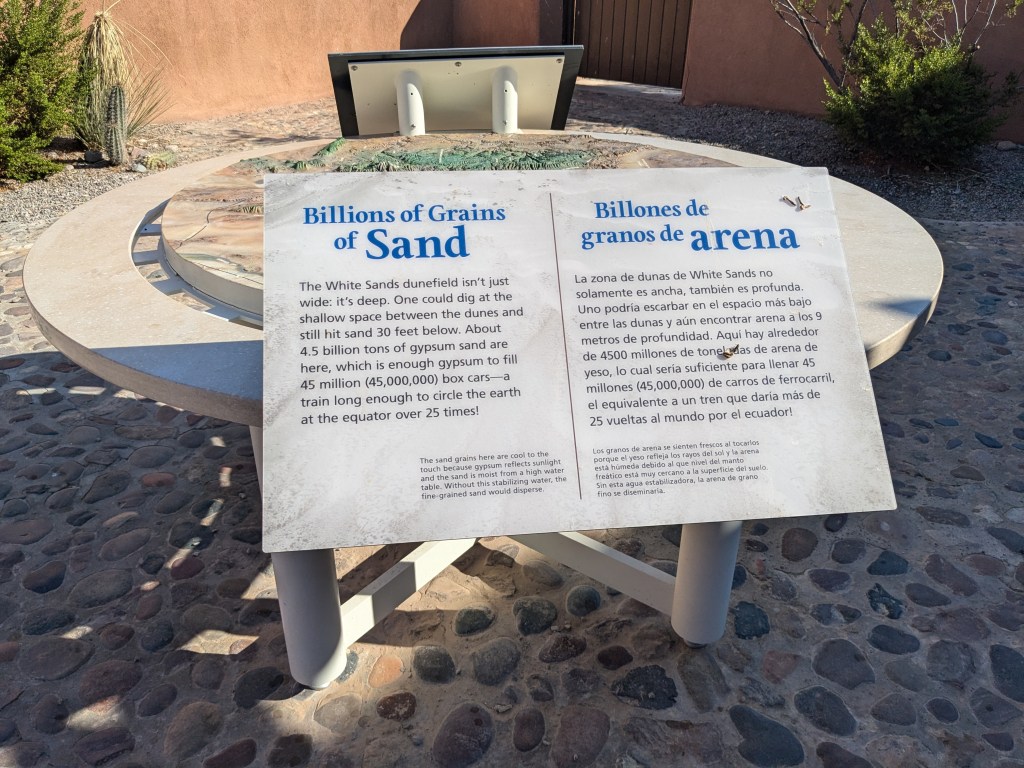
The gypsum comes from the San Andreas Mountains along the western edge of the dune field. Water washes it out of the rocks and down to the valley floor — another basin that gives up all its water to evaporation. As the water evaporates, it leaves behind gypsum crystals. The wind breaks these down into flakes and then into grains as fine as talcum powder by blowing them along, constantly replenishing the dunes and shifting them northeastward.
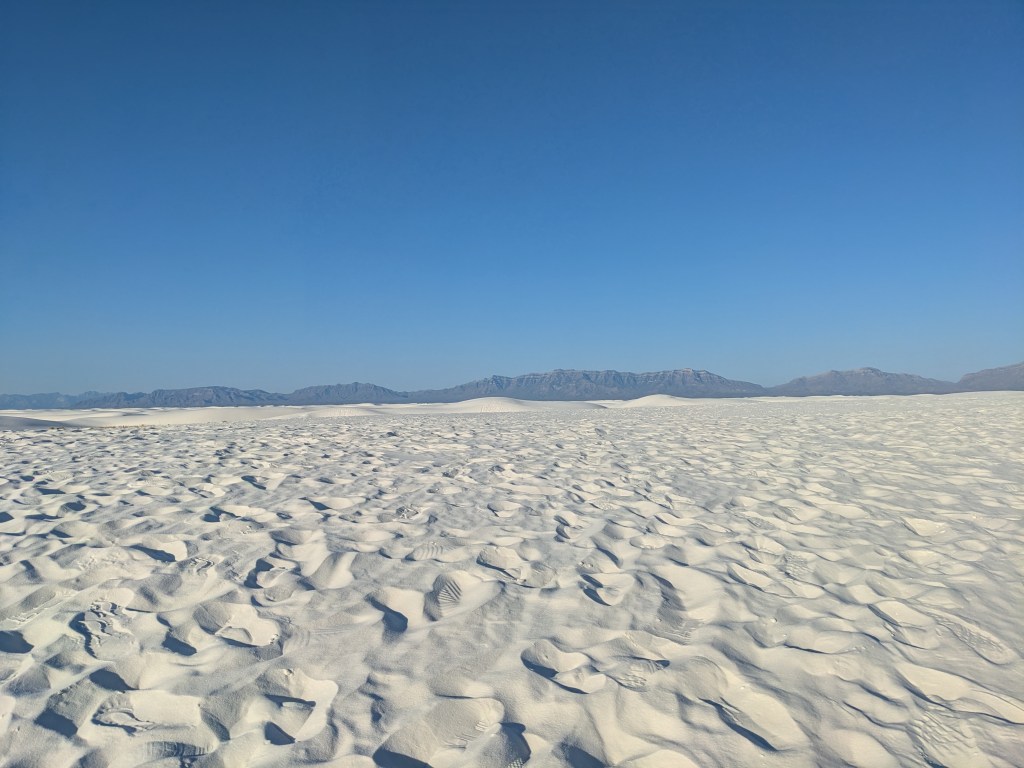
The park preserves a good bit of the dune field, but not all of it. White Sands Missile Range (best known as the original test site of the atomic bomb) wraps around much of the park and is still in use by the US military to test various explosive weapons. In fact, all the public information for the park warns visitors not to touch any metal debris they find, and to notify a ranger, because it may be unexploded ordinance. Boeing’s ill-fated Starliner capsule also landed there just a few days ago. (I’m kind of sorry I wasn’t here to see that!). Ironically, the fact that it’s “in the middle of nowhere” makes it a happening place.

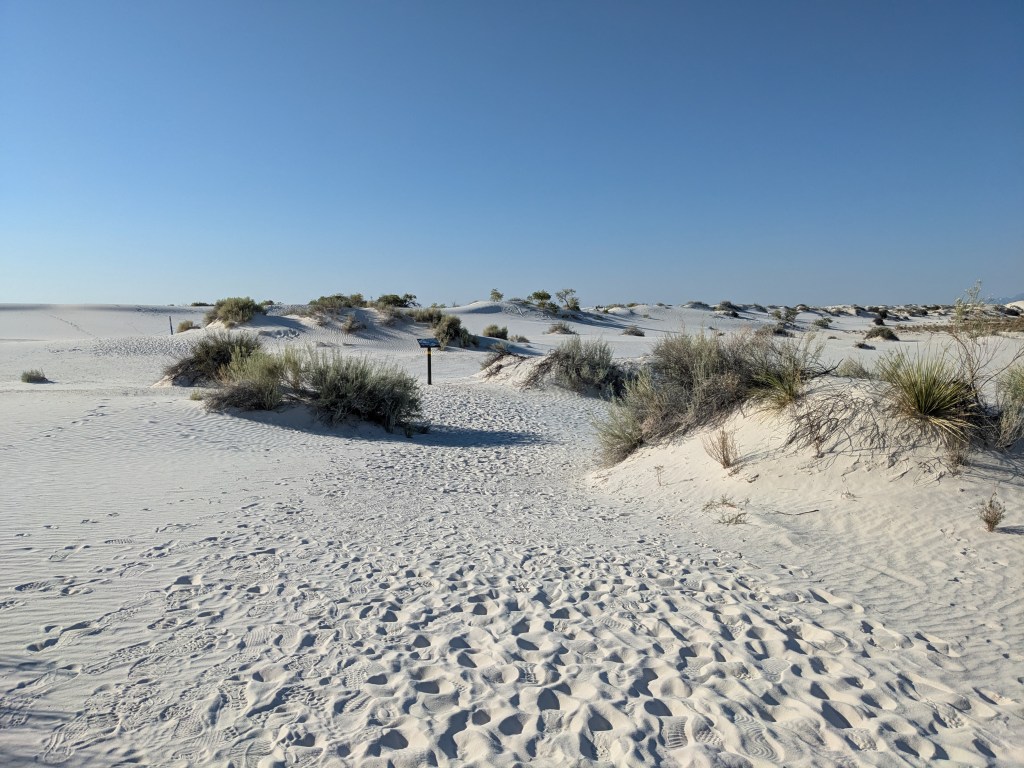
After driving around the loop, I stopped to do a one-mile hike on the Nature Trail. (I had actually planned to do the Intradune Boardwalk Trail so as to avoid getting sand in my shoes, but unfortunately it was closed.)
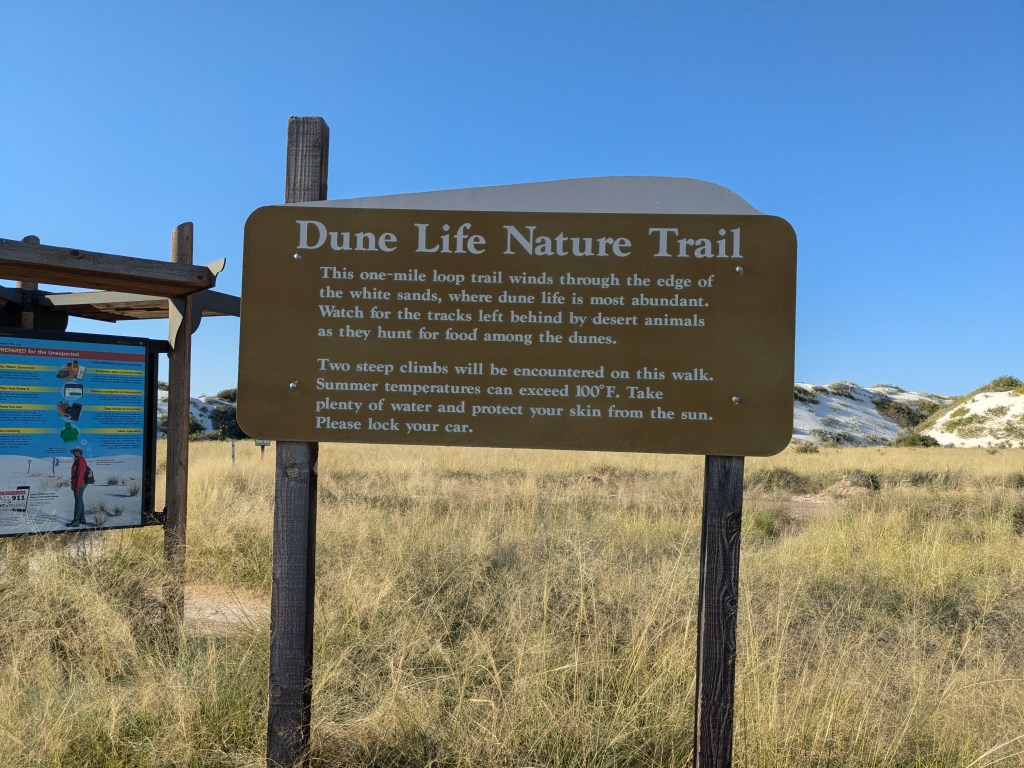
Once again, I was exceedingly glad to be there early before the day got uncomfortably hot.

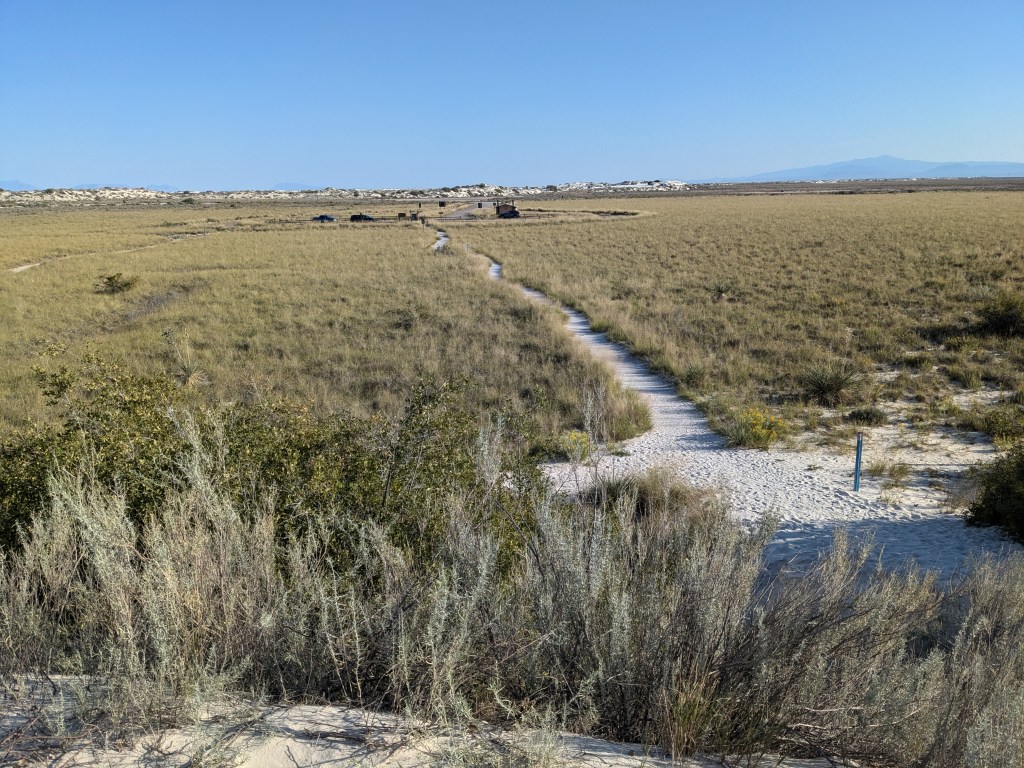
The trail was marked with blue wands that were easy to follow right up until the very end, when it seemed like there might be one or two of them missing. There was supposed to be a lot of interpretive signage also, explaining all the wildlife that lives in the desert, but sadly the harsh environment has cracked and faded most of it to illegibility. The ranger said that’s one of the things they are working on replacing, with signs made of a new experimental material that they are hoping will hold up better!
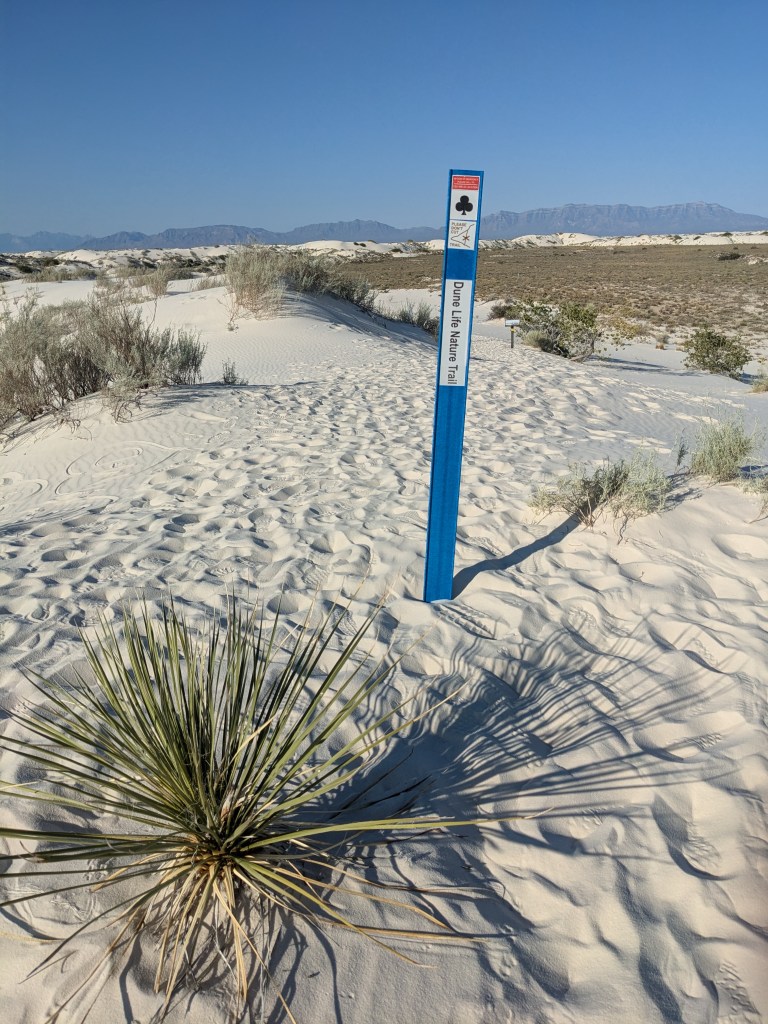
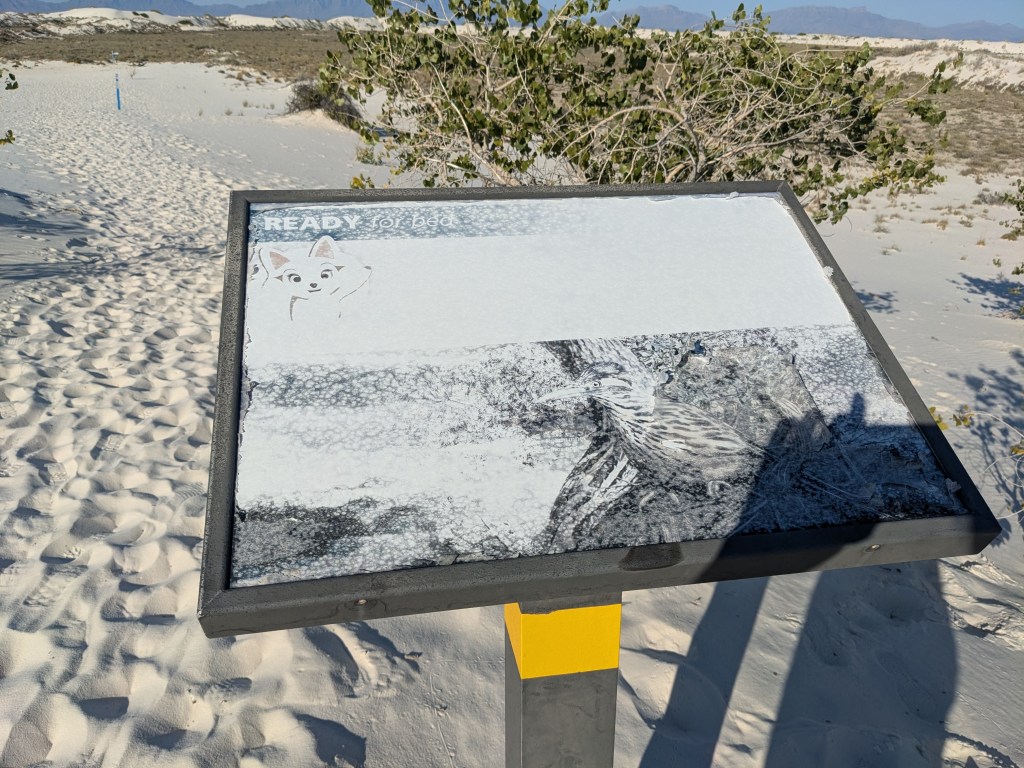
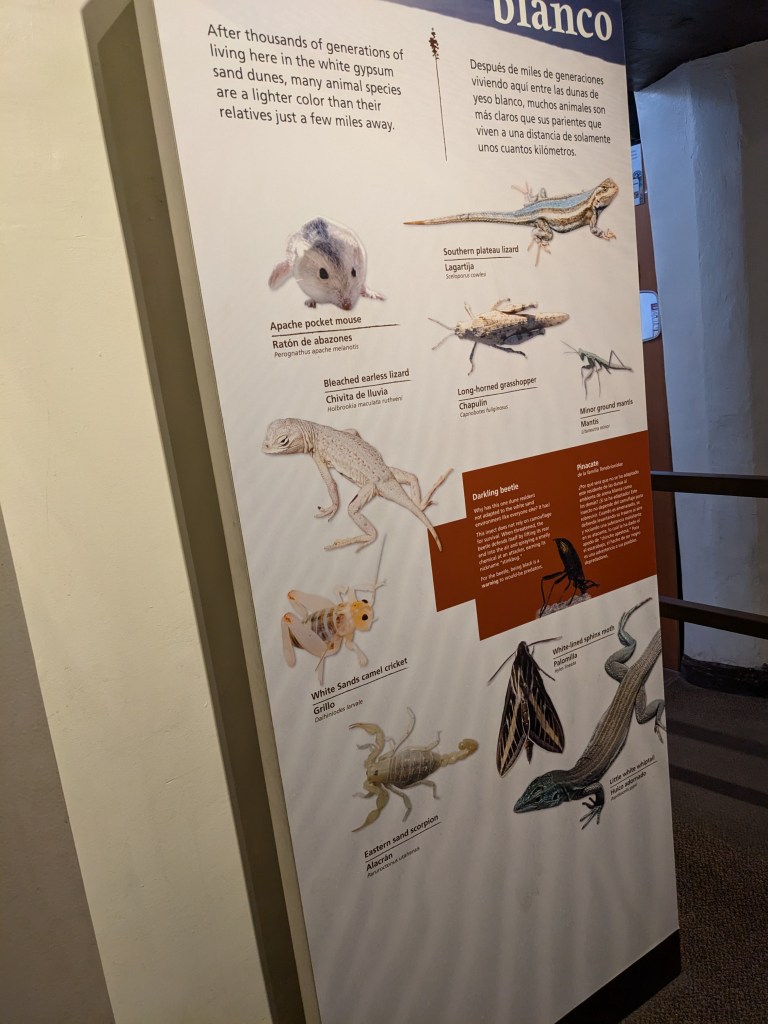
White Dunes is actually pretty wet for a desert — you can’t see the water, but a high water table just under the surface is what holds all that ultra-fine sand together. It supports a lot of wildlife, too, but most of the sensible creatures only comes out at night, so the most you can hope to see during the day is footprints.

I thought these might be bird prints, but from the information in the Visitor’s Center I think they might actually be from a beetle. I did spot one live gecko from a distance, but didn’t get a picture.
As I’ve said before, I’m not a lover of desert hiking in general, but getting up early makes a big difference and I managed to not get a ridiculous amount of sand in my shoes, so I did enjoy my walk.

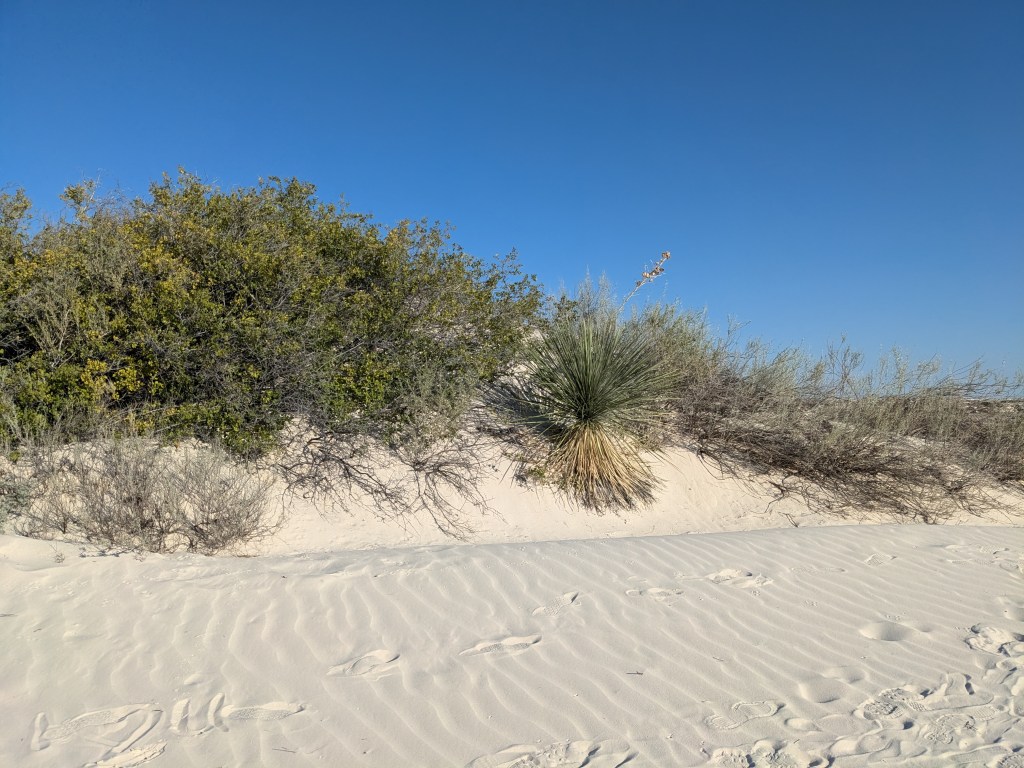
Climbing back down off the dune was pretty steep and that part of the trail wasn’t well marked, but I followed the myriad footprints back down to the level of the road.
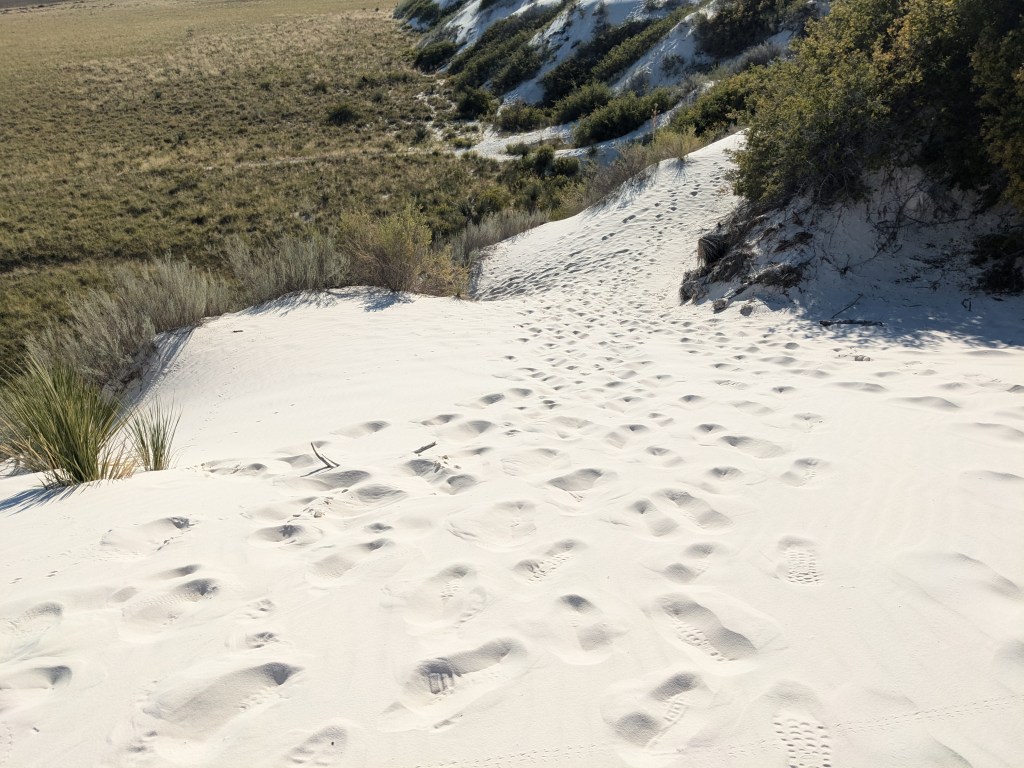
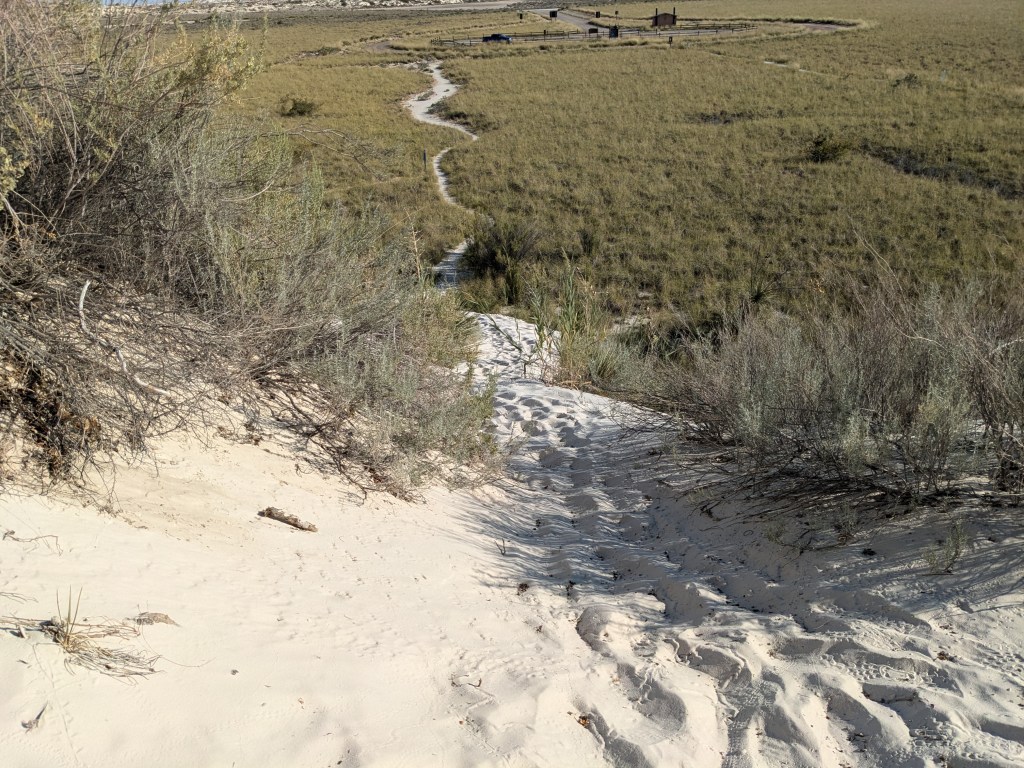
After my hike, I drove back to the Visitor’s Center and absorbed most of the facts I’ve been spouting back out here from the interpretive signs plus a short film.


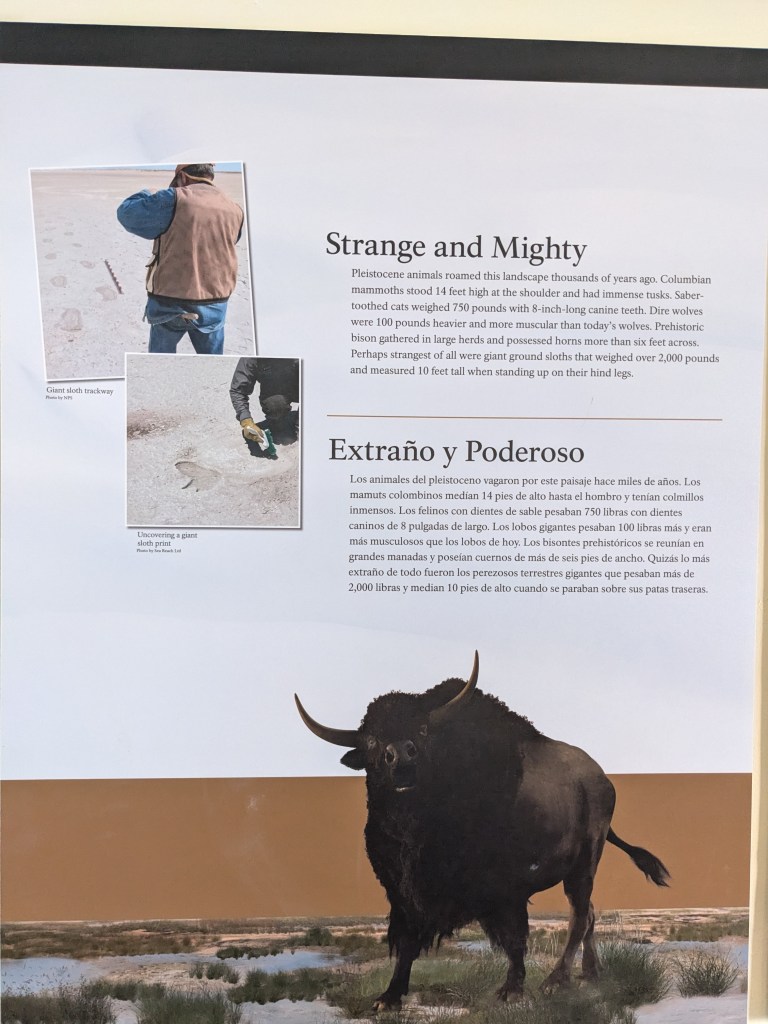
Dire wolves and ten-foot sloths must have made this place pretty interesting back in the day…
And with that, I wrapped up my visit to White Sands and to America’s National Parks for this year. Tomorrow morning I pull up stakes once more and start my long drive home. I’ll try to do one more post when I get there, summing up the summer and my current parks count. I’m leaving the remoteness of the desert for the warm humidity and cityscape of Houston, and right now it just feels right to be going Home.
 Vivian's RV Vignettes
Leave a comment