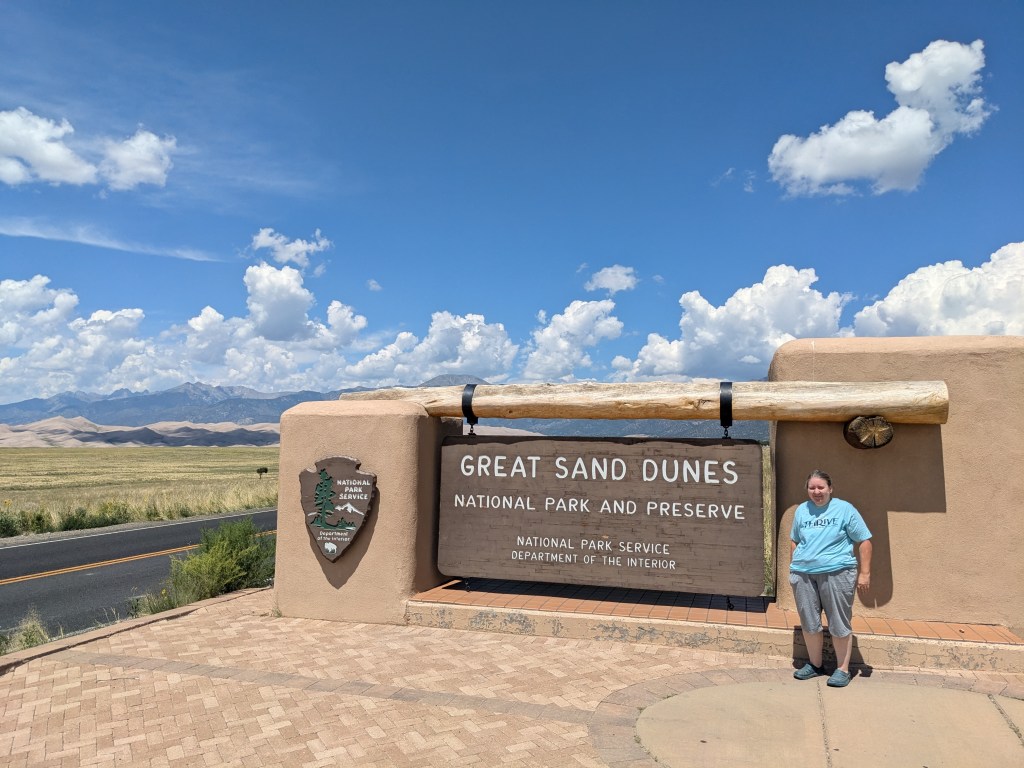
I’ll be honest, when I was thinking ahead about parks I would visit this year, Great Sand Dunes National Park in south-central Colorado didn’t top my list of places I was excited about. Beach sand is part of the seaside experience, and enormous inland piles of sand seem like a curiosity perhaps worth a few minutes of attention, but overall I share Anakin Skywalker’s feelings on the subject.

Still, somebody had decided it should be a national park, so I would check it off my list.
The park is a two and a half hour drive from my current camping spot at Thousand Trails Blue Mesa, meaning a five-hour round-trip, but it was still better to do it as a day trip than to take the whole RV with me and have to find somewhere else to camp. (I’ve been making those calculations all along my route for parks that are a few hours’ drive apart, and have added a couple of extra reservations instead of doing extremely long day trips in a couple of places, but sub-3-hours isn’t worth pulling up stakes for.) Fortunately, it was a beautiful drive through the mountains, and Skye the pickup truck scampered up high passes that Penelope the RV would have labored to clear. (Really not her fault, especially since I make her drag her little sister behind her everywhere.) I got some more use out of the Mountain Scenery playlist I made for Rocky Mountain National Park.
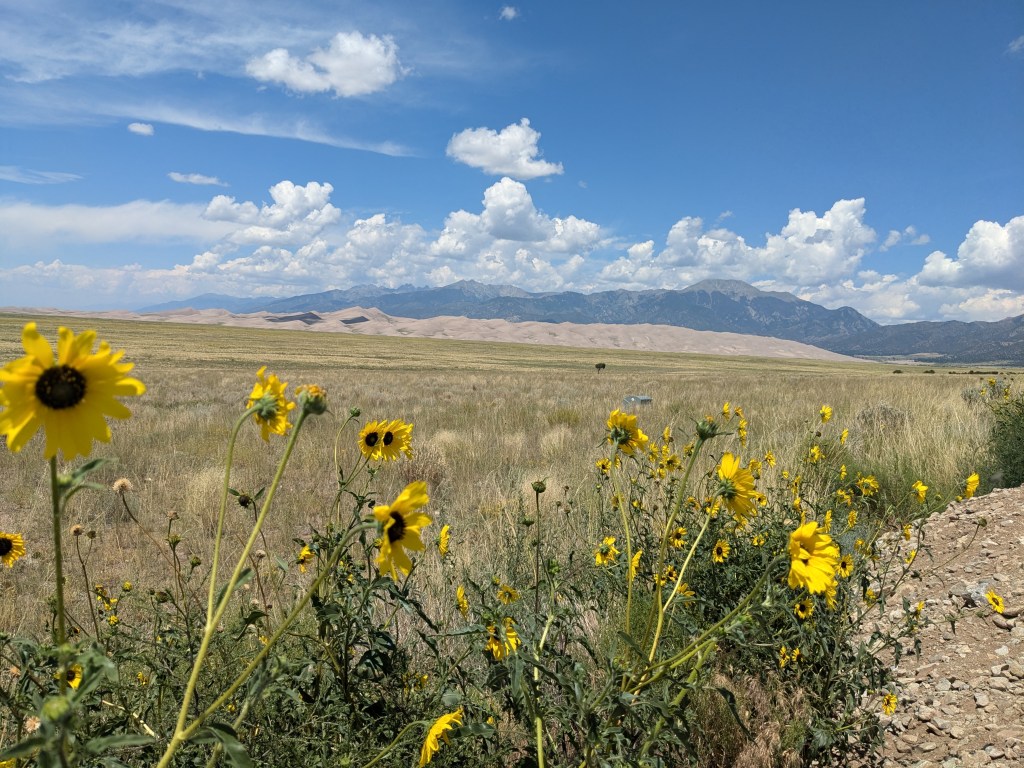
As I approached the park, I kept expecting the mountain scenery to peter out into more deserty terrain. I had pictured the dunes rising up out of some kind of sagebrush desert, but instead I found myself driving through a broad green valley between two chains of mountains, full of farmland and prairie grass and small wild sunflowers. I spotted the dunes miles before I got to the park entrance, and had another surprise. Rather than rising up from a flat plain, they were piled up at the base of the mountains. It looked as if a million billion dump trucks had driven across the prairie and tipped out their loads of sand just where the mountains rose out of it.
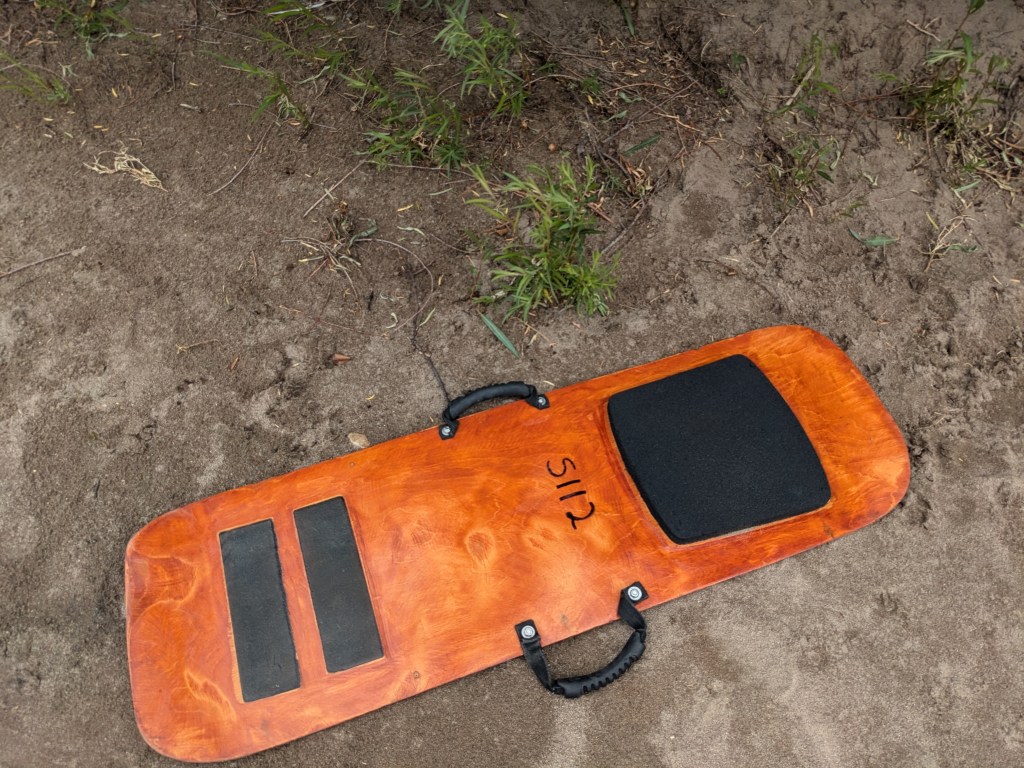
Forearmed by knowledge (courtesy of Google and the national park website), I stopped off at the Great Sand Dunes Oasis, the obligatory private restaurant/ gift shop/ gas stop just outside the park. They do brisk business renting out sand sleds and sand boards, specially surfaced and waxed to let people slide down the dunes. I thought it sounded like a more interesting way to experience the dunes than just walking on them, so I rented a sled. (No way was I going to do anything that involved sliding standing up! I like my legs unbroken, thank you very much.)
First, however, I went to explore the Visitor’s Center. I wanted to know what the heck all that sand was doing there, anyway. And of course, the Visitor’s Center obliged with all sorts of interpretive displays and a video to answer my question.
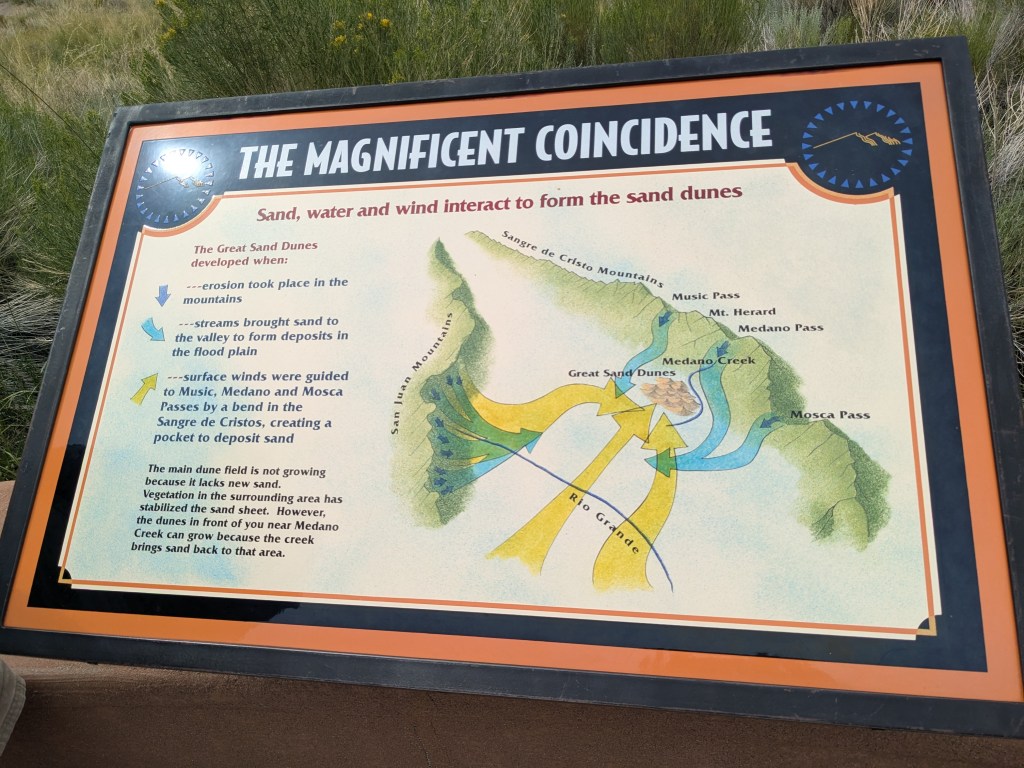
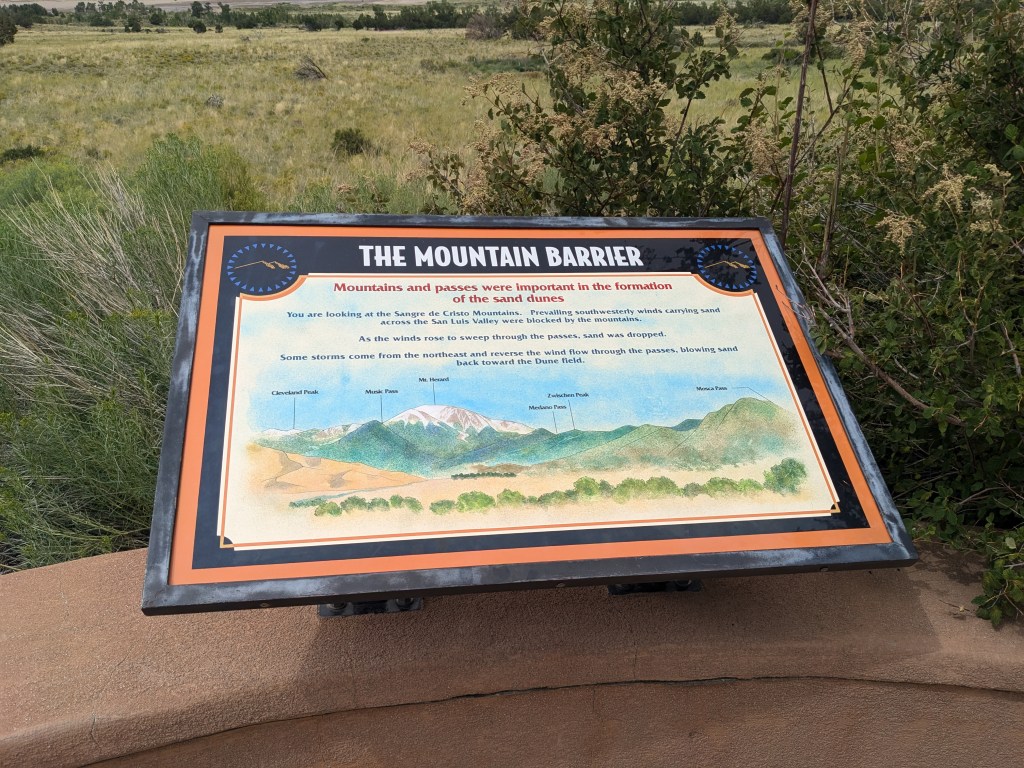
If you’ve ever had a particular corner of your house where the drafts tend to blow the dust and it piles up until you clean it, that’s a very good analogy for what happens here. The mountains make a sort of a funnel shape with a pocket at the base, and the prevailing winds blow all the eroded sand from the mountains 70 miles around into the pocket.
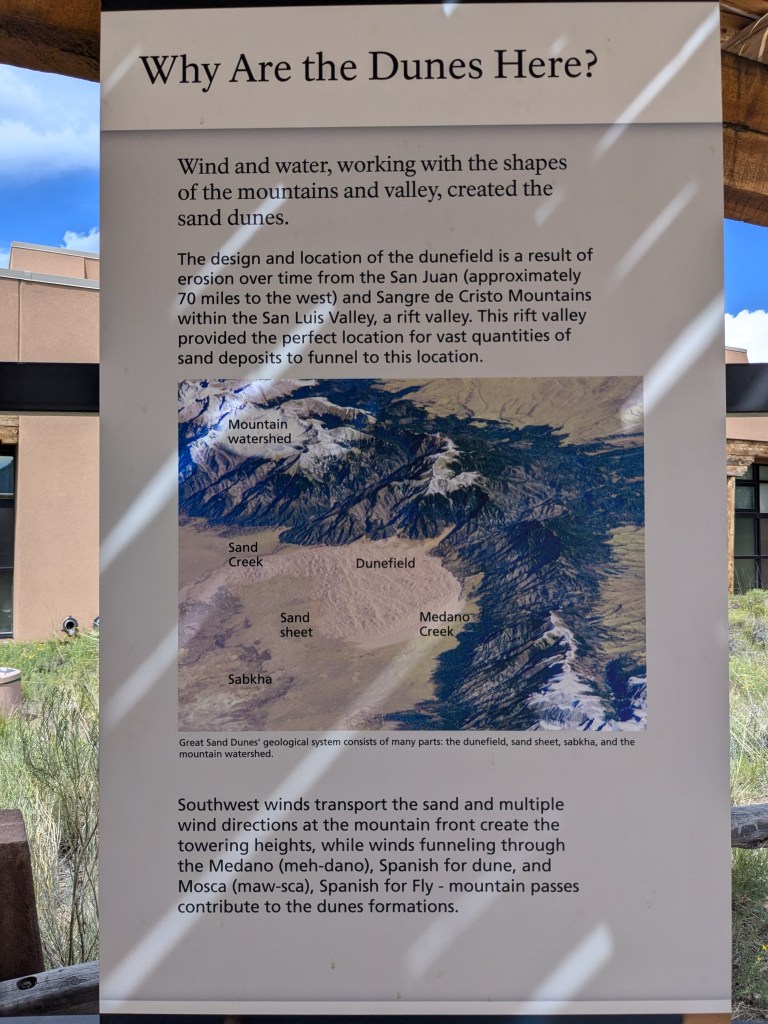
Wind drives sand up against the face of the Sangre de Cristo Mountains, but snow melt creeks on the mountain sweep the water back down to the base of the dunes and deposit it. Then the creeks dry up to a trickle in summer, and the wind picks up the sand and blows it back up onto the dunes. The dunes themselves occupy 30 square miles, but the sand field is 300 square miles…. there is sand under all that prairie grass that helps replenish the dunes. The whole system has achieved a sort of dynamic equilibrium. The wind is forever reshaping the dunes, but the total amount of sand in the system remains more or less the same.

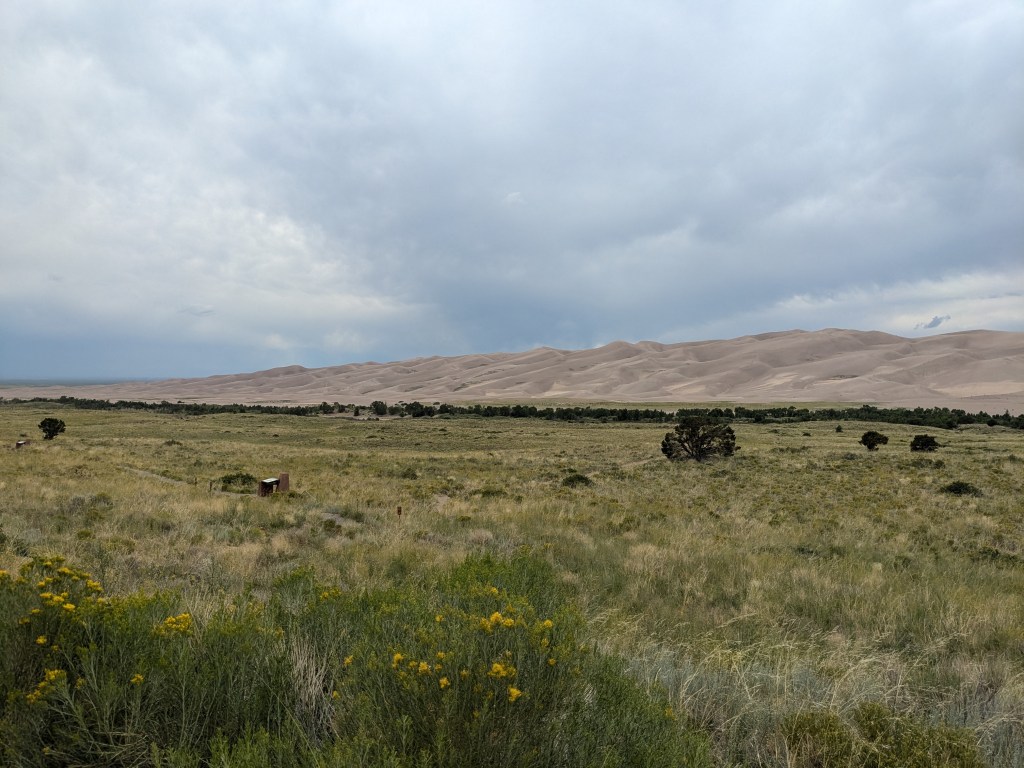
It was starting to look rather cloudy, and the forecast called for rain between 3 and 4 pm. The sand board rental place had told me not to let the board get wet, so I decided to do a short little drive along a “primitive road” in the park first to see what the weather was going to do. The road (which was indeed quite primitive) took me along the backside of the dunes and along the base of the mountains.

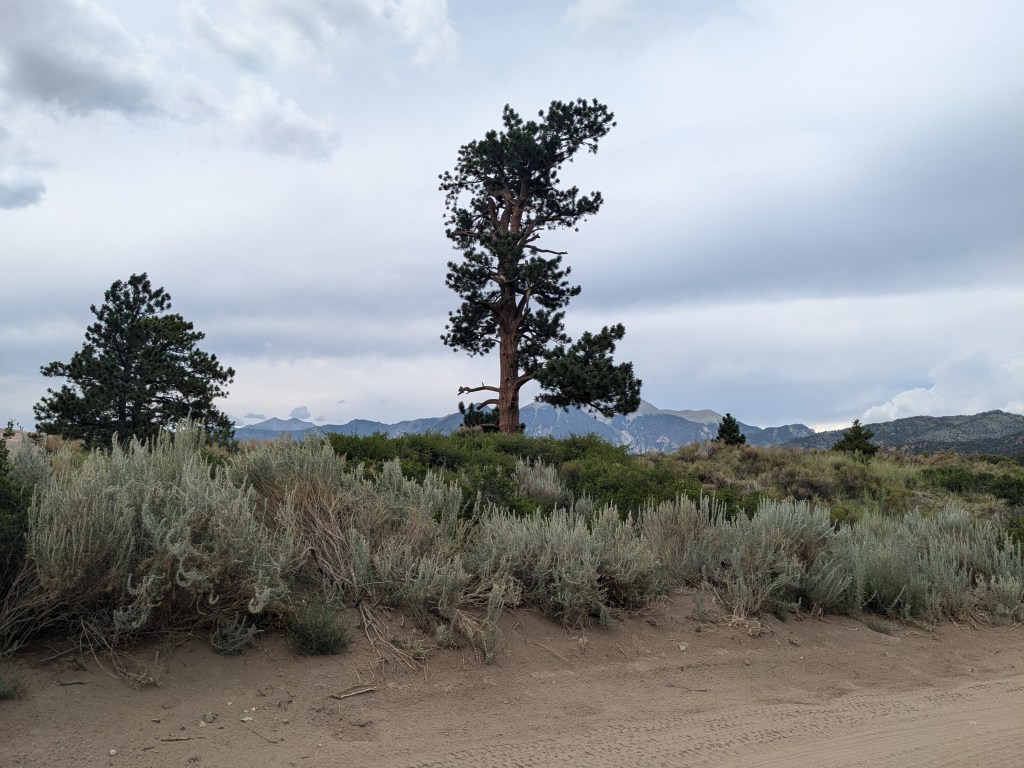
There was a magnificent specimen of ponderosa pine. One of the Visitor’s Center displays explained how the native peoples used to strip the bark from one side for use in cooking and medicine, but they’d leave the bark on the other side so that the tree could keep growing. There are still trees in the park that have a bare patch on one side from this practice so many years ago.
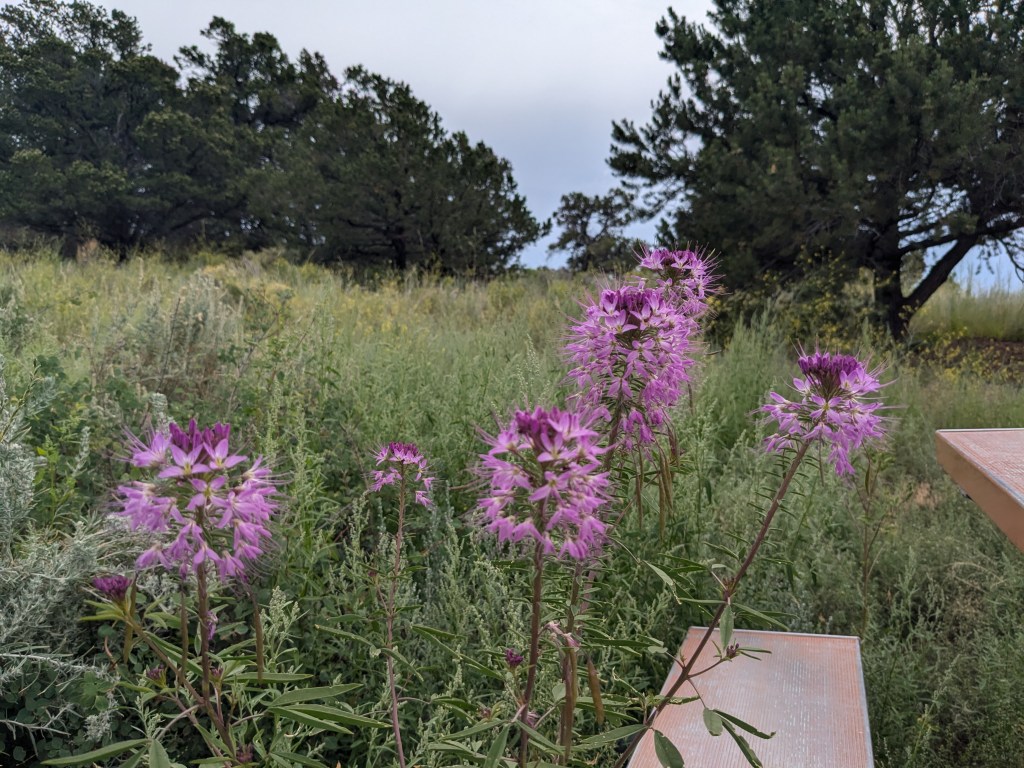
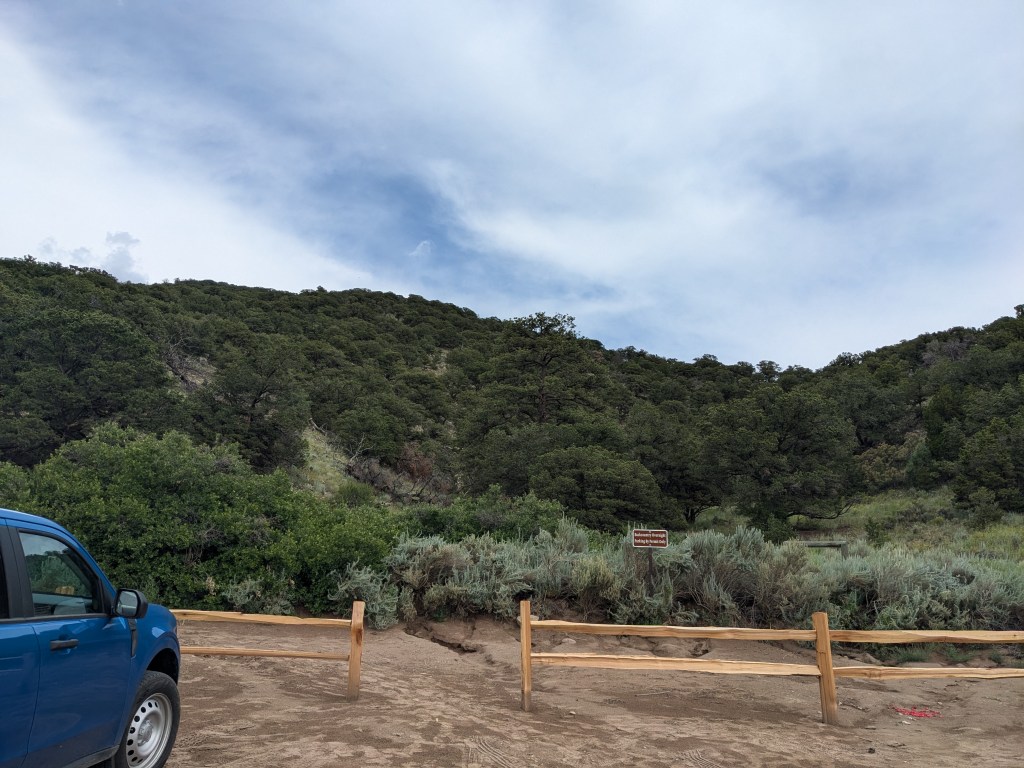
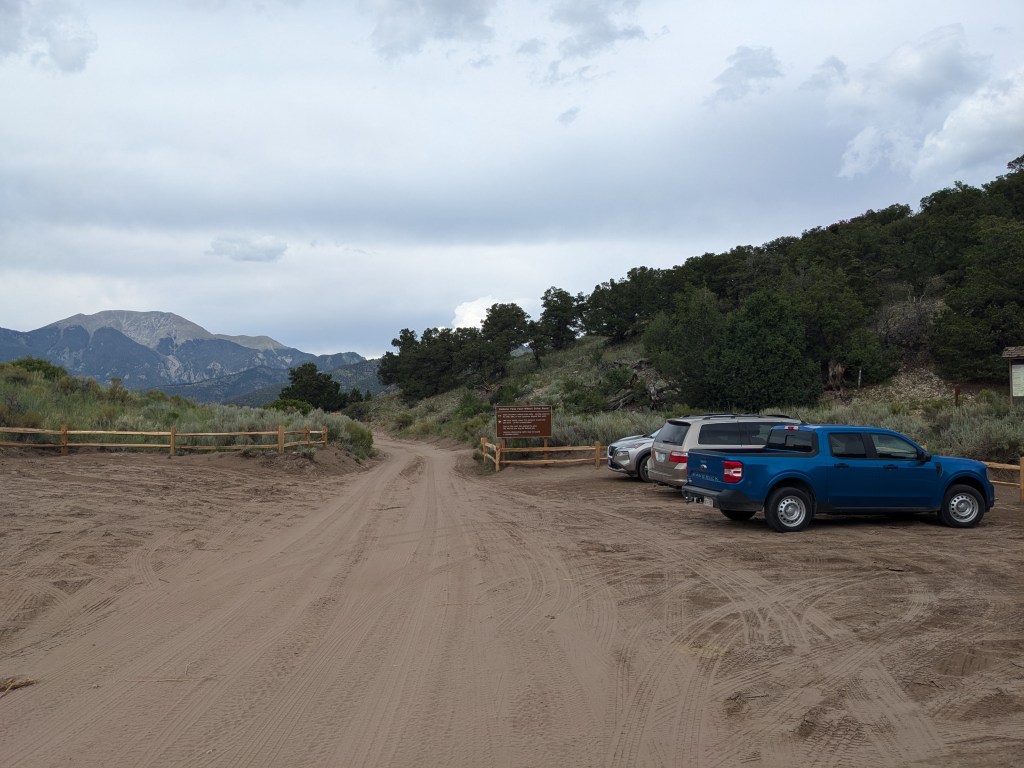
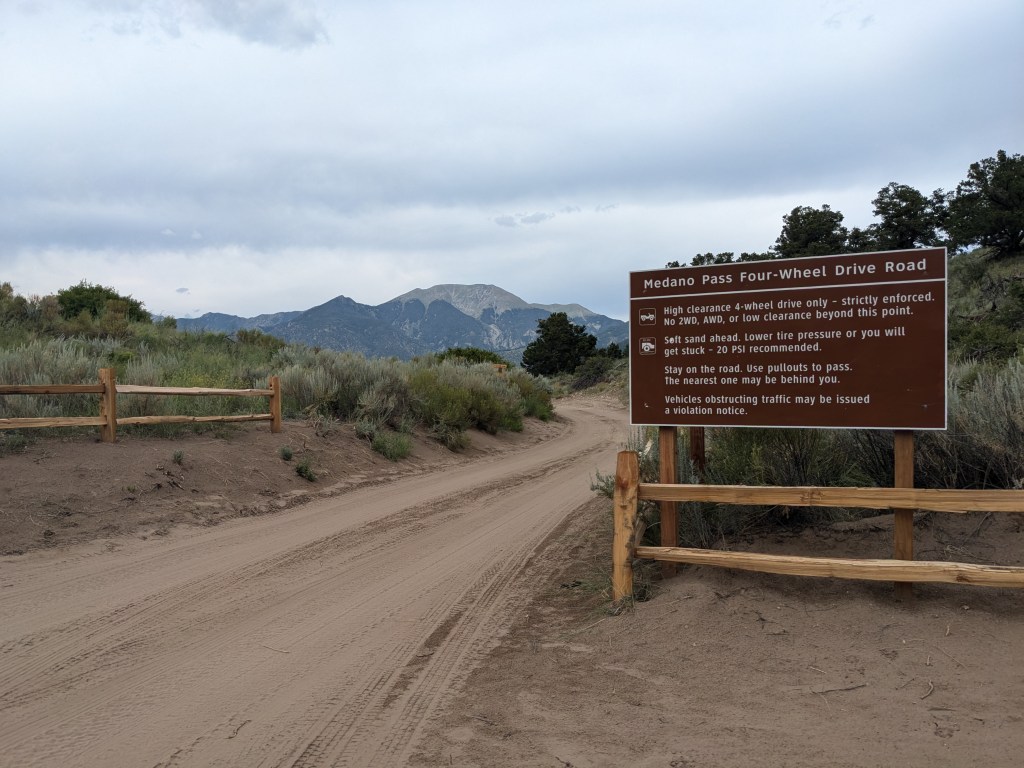
I turned back at the ominously named “Point of No Return.” The road beyond that is strictly for four-wheeled-drive vehicles, which Skye is not. The quiet there, on the backside of the dunes, was impressive. When I turned off my engine, the only thing I could hear was the wind. According to the map, the road continues all the way up to the mountain pass.
The weather still hadn’t made up its mind what it was doing, but I went back down to the parking area for the dunes and got my sand sled out. Turns out there is quite a trek to even get from the parking lot to the dunes themselves.
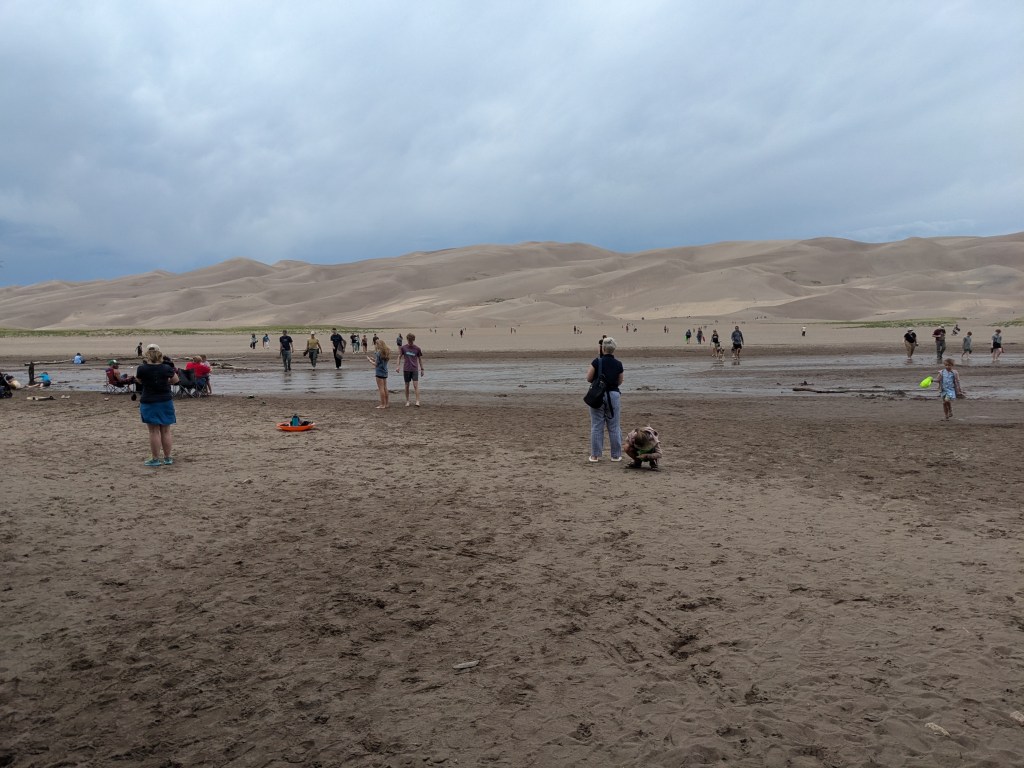
I had to cross the remnant trickles of Medano Creek, which is almost dry this time of year with all the snowmelt exhausted. Apparently in spring it becomes something closer to a river. The video in the Visitor’s Center explained that it has a unique characteristic when it is flowing, found on only a few places on earth: because it carries so much sand, it continually creates little dams in its own course and then washes them away, causing the current to “pulse.”
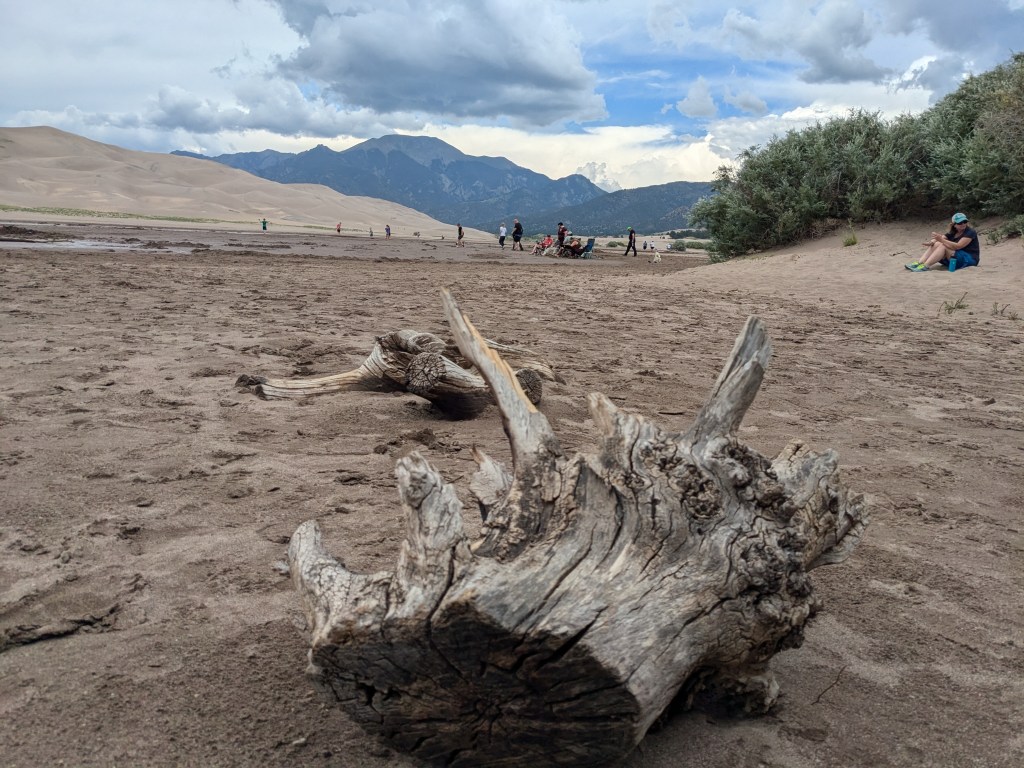
I set out across the sand field carrying my board. Overall I was glad that the clouds had rolled in. The Visitor’s Center had warned that the sand can reach 140F (60C) under the summer sun, but during my visit it was a comfortable temperature. When I looked down at my feet, I could see that the ground beneath them was continuously on the move, billions of little grains of sand migrating with the wind, creeping gradually towards the mountains. Walking on the loose sand was as annoying as walking on loose sand always is, though; it takes up so much more energy than walking on firm ground. And the wind kept trying to make my sand board into a sail. I felt like a character in an old western movie trekking across the desert. There was definitely rain coming down in the distance, but no more than a few sprinkles fell where I was.
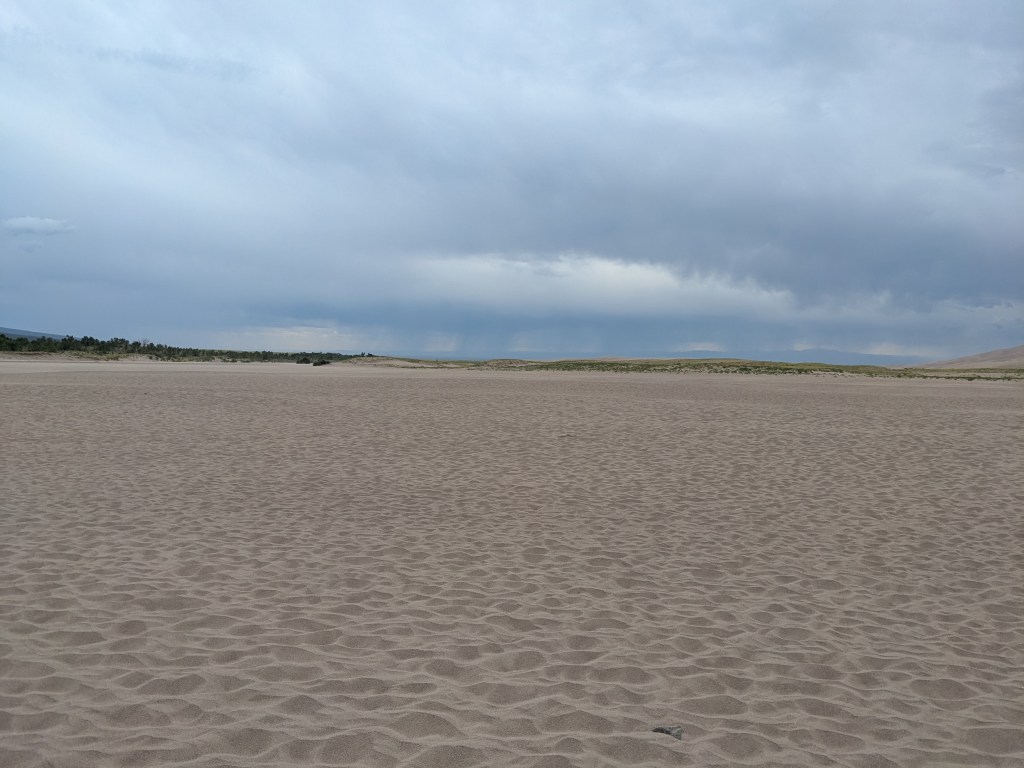
You might not realize from the pictures just how big the dunes are…
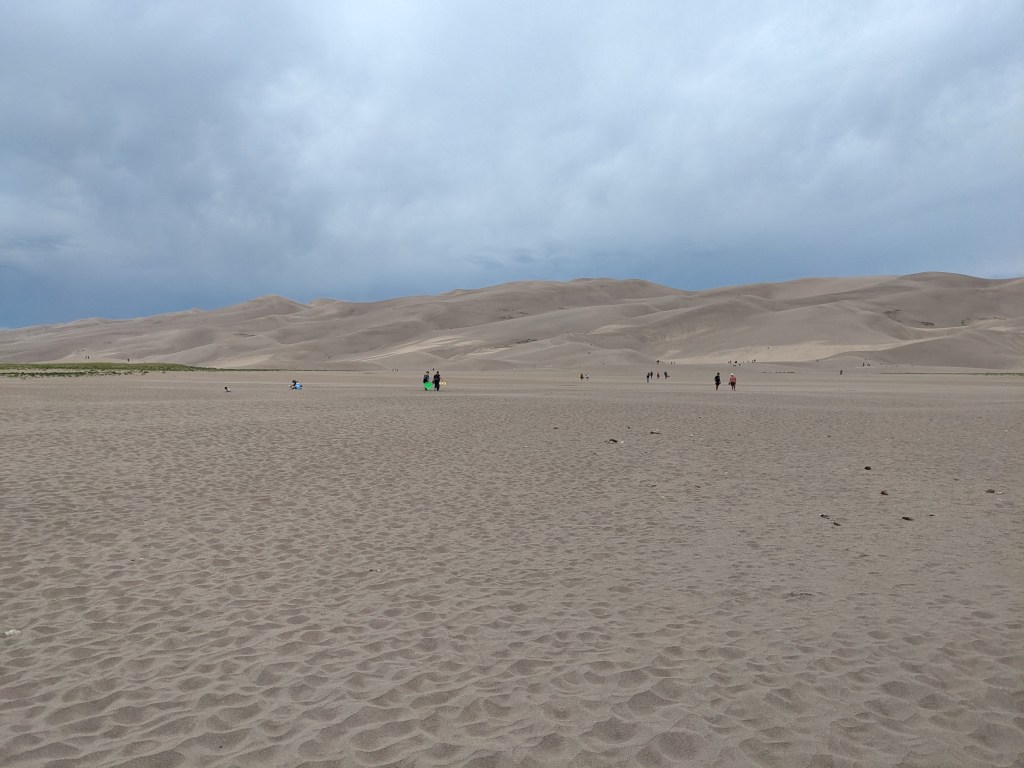
…until you zoom all the way in on this one and realize that those tiny black specks at the top are people.

Yes, people do hike all the way to the top. The Visitor’s Center estimated it was a two-hour hike to do so. I don’t know how they manage it. I would keel over if I tried (as will become apparent shortly from the rest of my story). The bottom of the dunes is over 8,000 feet in altitude, so we denizens of sea level are already at a disadvantage, and your feet sink deep into the sand with every step. It’s a genuine workout.
I didn’t even try that. I just climbed the lowest “bunny slope” dune right at the front, and tried a little sand sledding. I quickly discovered that it’s harder than snow sledding. My first two attempted runs didn’t go anywhere because I was trying to start on a “gentle” slope and I couldn’t get going. But I did manage two actual runs that were filmed for me by kind strangers. Warning: prepare to be unimpressed. It feels fast when you get going, but it doesn’t look like much. As per the (mumbled) safety instructions from the teenager who rented me the board, I kept my hands out to the sides to steer but kept my feet on the board. I think there were warnings of dire injury if I tried to stop myself with my feet…
What you can’t see, in between, is how I struggled to climb the hill with the sled in hand. Even just that short distance pretty much did me in. In between the first and second run, a kind gentleman from Denver saw how I was struggling to get up there and grabbed one handle of my sled to haul it and me up the last few feet. I was gasping so hard for air that I felt light-headed and had to lie down on the sand for a few minutes to recover. (I wished I’d had that bottle of oxygen I bought in RMNP, but I had left it back at the RV.) Once I was ready, he very kindly took my camera down the hill for me to film me from the bottom. (You can hear him cheering me on in the second video.) I was deeply appreciative of his help, and his fit mountain-bred lungs.
Once I got down there, I wasn’t going back up again. I was pretty much done for the day, so I hiked back to my car and went to turn my sand board in. I will say that Great Dunes National Park surprised me with its beauty, but didn’t change my basic feelings about sand. If all the other thousands of park visitors carry away as much of it on their body as I did, then there must be a lot of erosion from the mountain peaks to replenish what’s in the park and keep it at equilibrium! I’d rather admire the dunes from the edge than interact with them up close, frankly. But I understand why it was made a national park, and I’m glad I got to visit it.
The day had one more pleasure to give: my drive home through the “golden hour” light of sunset. I took a different route home along Colorado Route 114 through the Rio Grande National Forest, North Pass over the Continental Divide, and along the bottom of an awesome valley/ canyon along Cochetopa Creek. I came around one bend and found a small herd of bighorn sheep standing in the road. I didn’t get any pictures of my own, sadly, but here’s a representative picture for you.

Credit where credit is due: https://www.loc.gov/item/2015633064/
My gray water tank is no doubt full of sand after the shower I took. And that was my last national park visit for this campsite. Next weekend: on the road again, to Mesa Verde.

 Vivian's RV Vignettes
Leave a reply to Diane Espada Cancel reply